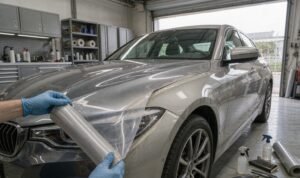
A customer sends you a screenshot last thing on Friday: a shop across town advertises full front PPF for $599, and he wants to know why your quote for the same job came in at $1,950. If you have sold paint protection for more than a season, you have had this conversation. And if you answer it with “our film is better quality,” you lose the customer, because that sentence has no numbers in it.
Here is the uncomfortable part. Both shops are telling the truth. The $599 shop really does a full front — by its definition. The problem is that “full front” has no industry-wide definition, and the gap between the two definitions is roughly 1.5 square meters of film, one thickness grade, and about seven years of warranty. When you can show a customer where that gap lives, the price argument ends.
The Four Numbers That Decide What the Quote Actually Buys
1. Coverage area, in square meters, panel by panel. A true full front on a mid-size sedan covers the complete bumper, the entire hood edge to edge, both full fenders, the mirror caps, and usually the headlamps — somewhere between 3.2 and 3.8 square meters of film. A “full front” in a discount ad is very often a partial front: bumper plus the leading 18 to 24 inches of the hood and the front inch or two of each fender, around 1.6 to 2.2 square meters. Same phrase, half the film. The partial package is a legitimate product — it intercepts the 80 to 90 percent of stone chips that land on those zones — but it leaves a visible film line across the hood and the rear half of the hood bare. Anyone selling it should say so plainly.
2. Film thickness and grade. Professional TPU PPF runs 190 to 215 microns (7.5 to 8.5 mil), measured per ASTM D374 with a tolerance of about plus or minus 10 percent. Budget film sold into these promos is commonly 6 mil, around 150 microns, and frequently aromatic rather than aliphatic TPU. The thinner stack absorbs less impact energy, and the aromatic chemistry yellows measurably faster — a Δb* shift beyond 3 points within two seasons is common on cheap film parked outside, versus the ≤2 points over 1,000 hours of ASTM G154 exposure that a quality transparent TPU PPF is specified to hold.
The downgrade never lands evenly across the stack, either. When a factory cuts cost, it trims the top coat from 10–12 microns toward 5, thins the adhesive from 25–35 down to 18–22 grams per square meter, and drops haze control last. If you want the full anatomy of where the money comes out, we wrote a separate breakdown of what a 30 percent cheaper TPU PPF roll actually loses. The short version: gloss on day one is identical, and everything that matters happens in year two.
3. Edge treatment. Wrapped edges — film tucked around the panel edge 3 to 6 millimeters — hide the line and keep lift-out from starting at a cut boundary. Cut edges sit exposed on the face of the panel, where a pressure-washer jet 30 centimeters away starts lifting within months. Edge wrapping costs the installer 30 to 60 extra minutes per front end. That time is a big share of why two quotes differ by four figures.
4. The warranty, on paper. Established film brands back a proper install with 7 to 10 years of non-prorated coverage on film defects — yellowing, cracking, delamination — plus workmanship terms from the shop. Promo installs typically carry 6 months to 1 year, sometimes on the film alone, not the labor. Check who issues the warranty: the film manufacturer, or only the shop that may not exist in three years.
| What to ask | Why it matters | Acceptable range |
|---|---|---|
| Coverage in m², panel list | “Full front” is not standardized | True full front 3.2–3.8 m²; partial 1.6–2.2 m² |
| Film thickness and grade | 6 mil aromatic film yellows early | 190–215 µm, aliphatic (ASTM D374, ±10%) |
| Peel adhesion | Out-of-range glue means lift or removal damage | 600–1,200 N/m (ASTM D3330) |
| Edge treatment | Cut edges lift and show lines | Wrapped 3–6 mm on hood and fenders |
| Warranty holder and term | Paper outlives the salesperson | 7–10 years film + written workmanship |
How to Audit the Quote in Ten Minutes
Step 1: Ask for the panel list. Not “full front” — the actual list. Bumper: full or partial? Hood: full or leading strip? Fenders: full or edge only? Mirrors included? If the answer is “bumper, 18 inches of hood, fender leading edges,” the customer is being sold a partial front, and the price is actually normal for a partial. That is the moment the comparison becomes honest.
Step 2: Ask for thickness in microns and the test basis. Any serious installer knows whether his film is 7.5 or 8.5 mil and what D374 says about tolerance. If the answer is “top quality, self-healing,” you have your answer anyway. A second tell: ask which TPU PPF grade the shop stocks for its own daily-driver customers. Shops quietly keep the good film for the clients who come back.
Step 3: Ask what happens at the panel edges. Wrapped or cut? On a dark paint, a cut line across the hood centerline is visible from ten feet in raking light.
Step 4: Ask whose warranty and how long. Get the term, whether labor is included, and what voids it. Many promo warranties exclude pressure washing and automatic car washes — reasonable — but also exclude “edge lift within the first 90 days,” which is precisely the failure mode a bad install produces.
Step 5: Ask for the roll label or lot code. A blank label means unknown origin. Reputable TPU PPF film carries a batch code that ties the roll to a production test report. This one question separates a film factory with quality control from a trading desk. If you buy film rather than installs, the same discipline applies upstream: any car film supplier who cannot put the lot code and the batch test report on the table in a minute is selling you a story, not a product.
What the Gap Looked Like in Practice
Two sedans, same model, same month, same city. Car A took the $699 “full front”: measured coverage 1.9 m², film at 152 microns, cut edges, one-year shop warranty. Car B took a $1,950 full front: 3.5 m², 205 microns, wrapped edges, ten-year film warranty.
At fourteen months, Car A’s hood strip had yellowed against the bare rear hood — the owner could see the line of demarcation — Δb* measured about 3.5 against the unwrapped reference, and four cut edges along the bumper were lifting. The redo: strip everything, paint correction, refit a proper full front: about $1,400 on top of the original $699, plus two days in the shop. Car B needed a wash. Total spend to date: A at roughly $2,100 and counting, B at $1,950, with a warranty that still has eight years to run.
The cheap quote was not a scam. It was an accurate price for a half-size, thin-film, short-warranty product that was marketed with the same words as the real thing. That is the whole trick.
The Line I Give Every Customer
A $599 full front is not a lie; it is a smaller product wearing a bigger name. Make the seller say the square meters, the microns, and the warranty holder out loud — if he will, you are comparing products. If he will not, that is your answer, and the extra $1,300 is not a premium, it is the price of not paying twice.