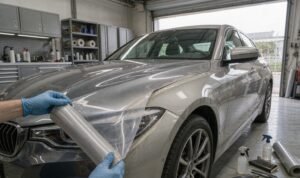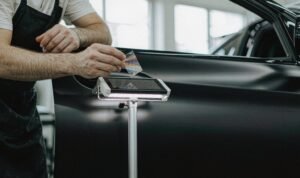
The pitch that fell apart in eleven seconds
A mobile installer in a city with a well-known car break-in problem sold a dealership service manager on security window film for a fleet of SUVs. The pitch was confident: this film makes the glass unbreakable, thieves move on, your cargo stays safe. Eight months later a parking garage camera caught the whole thing — a single hit with a pry bar, the tempered side glass shattering, the thief reaching through in about eleven seconds and out with a laptop bag. The manager asked for the fleet’s money back and quietly took the story to three other dealerships. Nobody in that conversation ever mentioned that the film was doing roughly what its data sheet said it would, and that the sale had oversold the standard.
Security film has moved back into the shop conversation since Ceramic Pro unveiled its Defense smash-and-grab film at SEMA 2026, and every North American metro with a break-in wave is getting pitched it right now. It is a legitimate product category with a real job to do — and it is also the easiest category in the car window tint world to oversell, because the difference between “buys you two minutes” and “glass cannot break” is a whole business model. Here is what the numbers actually support.
Four dimensions that separate film from marketing
Thickness, first. Security films are thicker than solar films for a reason: the film has to hold broken glass shards together and resist being pushed out of the frame. The industry ladder runs from roughly 100 microns (4 mil) entry-level smash-and-grab film, through 175 microns (7 mil) as the workhorse upgrade, up to 250-350 microns (10-14 mil) for high-security architectural-style work. Under about 100 microns, a determined hit can tear the film out of the glass along with the shards. The 100-125 micron band is the honest sweet spot for side-glass entry delay; anything thinner should be sold as a solar film with a bonus, not as security.
What the test standard actually measures. “Tested” means nothing without the test named. The two you will see most often:
- ANSI Z97.1 and CPSC 16 CFR 1201. These use a pendulum-swinging shot bag — Category I from a 150 foot-pound drop, Category II from 400 foot-pounds — and grade whether the glass stays in the opening or passes through. They are safety tests: they tell you the glazing holds fragments after impact, not that it resists repeated attack.
- EN 356. The European resistance ladder, P1 through P5, drops a 4.1 kilogram steel ball from 1.5 metres up to 9 metres depending on class, with higher classes adding tool attacks. P1 to P2 is where most automotive smash-and-grab claims actually sit, and a P1 rating on a 4 mil film is a fine, honest result — for one ball drop.
Note what none of these standards measure: how long a human being needs to get through the glass. That number comes from the installer’s own claims, and it is where the overselling lives.
Delay, in seconds. Unprotected tempered side glass gives an intruder entry in under fifteen seconds — a single impact and a reach-through. A properly specified and anchored 100-125 micron film typically adds thirty seconds to a few minutes of banging before an opening appears, because the shards hold together and have to be worked out of the frame. That is the real product: not prevention, but time. Now set that against how long an alarm response actually takes — five to ten minutes in most cities — and you get the honest pitch: the film rarely outlasts the police, but it comfortably outlasts the fifteen seconds a thief budgeted for, and a hit that makes noise for two minutes is a hit most opportunists abandon.
Optics and legality. Security film still counts as window film under your local tint law, so visible light transmission rules apply exactly as they do for any car film you install. Clarity matters more than on a dark solar film because customers expect an invisible layer: look for haze under 2 percent by ASTM D1003 and a specification sheet that states both. And remember the front windscreen is already laminated glass — it bends, it does not shatter and scatter — which is why serious security work concentrates on side and rear tempered glass, not on selling a windshield tint upgrade with a security story bolted on.
| What to ask | Why it matters | Acceptable benchmark |
|---|---|---|
| Film thickness | Below about 100 microns the film can tear out with the glass | 100-125 microns for entry delay; 200-350 for genuine resistance |
| Named test standard | An unnamed “tested” claim is not a claim | ANSI Z97.1 / CPSC 1201 Cat I-II, or EN 356 with the class stated |
| Edge treatment | A daylight-cut film can be pushed out of the frame whole | Anchored to the frame or edge-sealed, especially below 175 microns |
| VLT and haze | The film must comply with tint law and stay invisible | VLT compliant locally; haze under 2% (ASTM D1003) |
How to sell it without the refund
Step 1 — Quote by threat model, not by square foot. Ask what the customer is actually defending against: an opportunist with a spark plug, or someone with a pry bar and ninety seconds of nerve. The first is a 100 micron job; the second needs 175 or more with anchoring. Writing the threat down also protects you later, because you sold to a scenario, not to a slogan.
Step 2 — Match thickness to glass and frame. Older frames with worn channels hold film worse; thin film on a tired frame is where the eleven-second stories come from. Inspect the door glass edge condition before you quote, and budget the extra film that anchoring consumes at the edge.
Step 3 — Decide the edge treatment and say it out loud. A daylight cut is faster and cheaper but is the weakest configuration under repeated impact. Frame anchoring — bonding the film edge into the window channel or sealing it to the frame — measurably improves hold, and it is the single biggest difference between a demo that works and a break-in that does not.
Step 4 — Install and cure like a solar film. Same squeegee discipline, same water removal, same patience: the adhesive needs time, with full cure typically inside thirty days and no aggressive inside cleaning for at least the first week. Rush the cure and your first repeated-impact event becomes a peeling event instead.
Step 5 — Demonstrate the expectation, not the miracle. The best closing tool in this category is a small demo panel: hit it, show the glass shattering and holding, then say the sentence that keeps you out of refund territory — the glass will still break, the film buys minutes, the alarm does the rest. Customers who hear that sentence never feel sold to.
The case in numbers. Two fleets in the same city. Fleet A got 100 micron film, daylight cut, sold as unbreakable: one break-in, eleven seconds to entry, a 2,400 USD laptop stolen plus a refund demand on a 980 USD film job and a lost dealership account. Fleet B got 175 micron film with frame anchoring on the doors and the same honest five-sentence pitch: two attempted break-ins in a year, both abandoned — the first after roughly ninety seconds of noise against a seven-minute police response, the second the thief gave up inside a minute. Fleet B’s losses: two side-glass replacements at about 350 USD each, zero cargo, zero refunds, and a service manager who now sells the film himself.
The takeaway
Security film is not a force field and never was — it is a clock, and the honest pitch is that thirty seconds of noise beats fifteen seconds of silence every single time. Shops that sell the standard, the thickness and the anchoring get to keep the customer; shops that sell “unbreakable” get eleven seconds, one pry bar and a refund form. Sell the clock, and let physics do the closing.
If you want the performance-numbers conversation to stay consistent across your whole film menu, it pairs naturally with how window tint film performance is quoted on the solar side — IRR and TSER are the same discipline: name the metric, name the test, or do not sell the number.