The film comes off clean, and the phone rings two days later
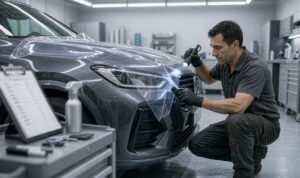
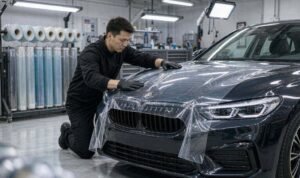
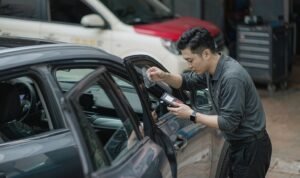
A shop pulled a four-year-old full wrap off a customer’s sedan before a lease turn-in. The Car Wrap Vinyl released in clean sheets, warm at 55 degrees, adhesive wiped away with one IPA pass. Textbook removal. Two days later the customer called: the hood and doors look darker and richer than the door jambs and the edges of the engine bay, and the lease inspector is coming Friday.
Nothing was damaged. The paint under the film simply stopped aging in 2022 while everything around it kept going. The customer will call it damage anyway, and if nobody measured anything, the argument ends with a free hood repaint and a review you cannot answer honestly.
This is the part of the wrap business nobody prices at the point of sale. The removal is quoted, the adhesive is discussed, the paint-condition disclaimer is signed. What almost never appears on the invoice is the shadow: the measurable color and gloss difference between panels that spent four years under film and surfaces that never did. It is not a defect, it is differential UV aging, and it is fully predictable from three numbers you already know at quotation time.
What the shadow actually is
Clearcoat ages from the top. UV breaks down the surface matrix year after year: micro-chalking, gloss loss, a slow drift in hue on effect pigments. Panels under film skip all of it. When the film comes off, you are left with two populations of paint on one car, and the eye picks up the boundary instantly on horizontal surfaces, where sun hours accumulate fastest.
The honest way to describe it is with a measurement, not an adjective. Delta E 00, per ASTM D2244, read with a spectrophotometer at D65 and a 10-degree observer, comparing each formerly wrapped panel against a never-covered reference such as a door jamb or a door edge. On a full wrap removed at three to five years with outdoor parking, the drift between covered panels and reference surfaces typically lands between 1.5 and 4 delta E. Below about 1.5, most eyes see nothing at arm’s length. Above 2.5, the customer sees it before you point at it.
Two aggravating factors are worth naming. Dark and saturated colors, especially black, deep red and blue metallics, show the drift far more than silver or white, which mostly argue about yellowing. And partial wraps or cut lettering produce the nastiest version: outline ghosting, where the boundary is graphic-sharp rather than panel-wide, so there is no big soft transition to hide behind.
The four numbers that size the bill
1. Film age at removal. Under three years, drift is usually 1.5 delta E or less and often invisible. Three to five years on quality cast film lands in the 1.5 to 3 band. Past five years, or on budget calendered film that offered little UV opacity to begin with, expect 3 to 6 and plan for real correction work.
2. Exposure history. A garage-kept car and a street-parked car of the same age can differ by a factor of two in drift. Horizontal share matters most: hoods and roofs take square sun hours, so on a full wrap the shadow concentrates exactly where the customer looks first.
3. The reference surface you measure against. Jambs, door edges and the underside of the trunk lid never saw film and never saw sun, which makes them the control group. Five points per panel, recorded, is what turns a complaint into a number.
4. The correction budget behind the measurement. A single polishing pass removes roughly 0.5 to 2 microns of a 35 to 55 micron factory clearcoat. Drift that lives in the oxidized surface layer and the gloss level equalizes in one to two passes. Drift that lives in the color coat itself, true pigment fade, does not polish out at any depth worth removing, and that panel goes to repaint at 400 to 900 dollars each.
| What to check | Why it matters | Acceptable range or action |
|---|---|---|
| Film age at removal | Sets the expected drift band before you touch the car | Under 3 yrs: usually ≤1.5 ΔE; 3-5 yrs: 1.5-3; 5+ yrs: 3-6 |
| Parking and orientation history | Halves or doubles the drift for the same age | Hood/roof always measured separately from verticals |
| ΔE 00 vs jamb reference (D2244, D65/10°) | Converts the complaint into a number both sides accept | ≤1.5 invisible; 1.5-2.5 negotiable; >2.5 correct or disclose |
| Drift type: surface vs pigment | Decides polish or repaint | Gloss-level drift: 1-2 passes; pigment fade: repaint 400-900 USD/panel |
The protocol that keeps the money and the relationship
Step 1: predict before you peel. At quotation time, age plus parking history gives you the drift band. Quote the correction as a named line item then, not after the complaint. A removal quote that says “paint shadow correction if measured over 1.5 delta E: 250 to 450 dollars” reads as expertise, not upsell.
Step 2: remove warm and slow. Film surface at 50 to 60 degrees, peel angle at or below 45 degrees, steady pull back on itself. The removal craft rules have not changed and the shadow is not affected by them, but a rushed cold peel adds adhesive haze on top of the shadow and muddies the measurement.
Step 3: decontaminate and wait. IPA wipe, then let the panel sit 48 hours before measuring. Freshly exposed paint outgasses and its gloss reading moves for a day or two; measuring too early gives you a number you will have to defend twice.
Step 4: measure and classify. Every formerly covered panel against the jamb reference. Under 1.5, document and deliver. Above 1.5, decide per panel whether the drift is gloss-level, which polishes out, or color-level, which does not.
Step 5: correct the exposed panels, never the shadow. The counterintuitive half of the job. You level the car by polishing the sun-aged surfaces down to match the preserved zone, not the other way around; cutting into the shadowed panels spends clearcoat you cannot refund. One or two fine-compound passes on hood, roof and fenders, then seal the whole car with wax or ceramic so the two populations stop diverging.
Step 6: hand over the file. Baseline numbers, correction performed, and the sealant applied. That file is what the lease inspector, the next buyer and your own future self all read the same way.
A worked case: the sedan from the opening, 2022 wrap, four years, street parking. Hood and doors measured 2.6 to 3.1 delta E against the jambs. Correction ran one and a half passes on the hood, roof and front fenders, three and a half hours at 85 dollars an hour, about 300 dollars, and the final read was 1.2. The customer paid the line item quoted at removal, the lease inspection passed with no deduction, and nobody repainted anything. The control version of this story is a shop that skipped the measurement, heard “the paint looks different” at handover, and ate a 700 dollar hood repaint plus the turn-in delay for free.
One disclosure worth adding for customers weighing options: the same physics governs any film that stays on for years. A Color TPU PPF build also carries a pigment layer that drifts on its own schedule, so the shadow conversation belongs in those quotes too, alongside the color-fastness terms.
The measurement discipline here is the same one used for matching a single wrapped panel after a repair, just applied to the whole car at once.
The stance
The shadow is not a failure of the film, but it becomes a failure of the shop the moment it is discovered instead of predicted. Every wrap quote already contains the three inputs needed to price it: film age, parking history, and a reference surface. Put the correction on the invoice before the film goes on, measure before you argue, and de-wrap day turns from your most common dispute into your easiest upsell, and one more reason owners come back to the same car film shop for the next install.