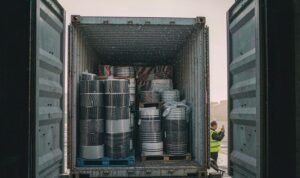
The container doors come open at 8:40 in the morning and the air inside is warmer than the yard. Water is beaded across the underside of the roof. Three rolls in the top tier have liner that has gone wavy and dull where it was wet. The driver is standing there with a delivery receipt and a pen, and he would very much like a signature.
If you sign clean, you own those rolls. Not in theory: the forwarder sends you a copy of your own signature six weeks later and the file closes. The damage was real, the cause was ordinary, and the claim still dies because nobody photographed the roof before the first roll moved.
Car wrap vinyl is dense, heavy and packaged well enough to survive handling. It is not packaged to survive a container that spends three weeks crossing climate zones with warm, humid air sealed inside it.
Four things decide the claim before the film is even unrolled
1. Evidence that exists for about twenty minutes
The seal number, the container number, the roof, the load pattern, and where the water landed. After devanning none of it can be reconstructed, and a surveyor will say so in writing. The deadlines are unforgiving: written notice to the carrier within about three days under the Hague-Visby rules and the US Carriage of Goods by Sea Act, a surveyor on site within 24-48 hours, and notice to your cargo insurer within the 30 days most policies specify. A clean receipt does not automatically kill every claim, but it moves the argument from “this happened in your custody” to “prove it”.
2. Container rain, which is physics rather than bad luck
A 40-foot box holds roughly 67 cubic metres of air. Warm humid air gets sealed in at origin, the steel roof radiates heat at night, drops below the dew point of that trapped air, and water condenses on the underside and drips down. The tell is distribution: damage concentrated in the top tier points to roof condensation, damage in the bottom tier points to floor ingress or a wet container at loading, and uniform damage points to cargo that was already wet when it was stuffed. Where the water sits often settles causation, which is why the photograph matters more than the argument.
Paper cores and PET liner both take up moisture. A roll that looks fine on the outside can have a liner that has cockled and an adhesive that has hazed at the edge, and that only shows up once the film is on a panel.
3. Damage you can measure on the bench
Do not judge by eye at the door. Four measurements separate a roll you can sell from a roll you should quarantine:
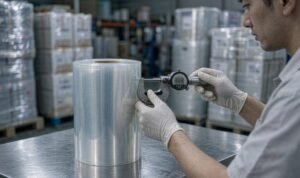
- Core ovality: measure the core bore at two axes. More than 3% out of round on a 76 mm core, about 2 mm, and the roll will not track properly on the plotter.
- Telescoping: the outer wraps sliding sideways. Over 10 mm needs re-winding before it can be cut.
- Edge crush: film damaged within the first 2 mm of either edge is unusable on every wrap you cut, because the edge is what the customer sees.
- Liner and adhesive: any water staining, cockling or release that feels heavy. Cut a 300 mm coupon and pull it against a known-good roll. Normal release runs 600-1,200 N/m on ASTM D3330; a wet liner commonly reads under 400 and will leave adhesive behind on removal.
4. What the claim is actually worth
A 40-foot container of mixed film is a five to six figure invoice. At 5% affected, the material exposure is 3,000-7,500 US dollars, against twenty minutes of photographs. Add the part nobody puts in the claim: re-order lead time of 25-45 days, and air freight at 6-9 US dollars per kilogram if you need four rolls to keep a booked job. Recovery is usually material only, often 40-70% after the surveyor’s fee, and almost never labour or lost margin.
| What to ask | Why it matters | Acceptable range |
|---|---|---|
| Was the seal photographed before cutting? | Proves the custody chain and rules out pilferage or a resealed box | Seal number and container number legible, seal intact in frame |
| Where is the damage in the stow? | Top tier means roof condensation; bottom tier means floor ingress; uniform means it was loaded wet | Damage mapped by tier and position before anything is moved |
| What is the core ovality? | An out-of-round core will not track, and the roll is scrap for cutting | Within 3% of bore, about 2 mm on a 76 mm core |
| Is the liner sound? | Water in the liner shows up later as adhesive transfer on the car | No staining or cockling, release 600-1,200 N/m on a 300 mm coupon |
| How deep is the edge damage? | Crushed edges cost you film on every panel, not just one | No damage inside 2 mm of either edge |
| When does notice have to be filed? | The claim dies on the calendar, not on the merits | Carrier 3 days, surveyor 24-48 hours, insurer 30 days |
Receiving a container: seven steps
Step 1 — Brief the receiving team 48 hours before arrival. One name on the camera, one on the phone, the carrier’s claim desk on the same sheet. A crew that meets a container without instructions will unload it in forty minutes and destroy the evidence doing it.
Step 2 — Photograph the seal and the doors, closed. Wide shot with the container number, close-up of the seal, and one shot of the door gaskets. If the seal is broken or mismatched, stop and call before cutting.
Step 3 — Open the doors and stand still. Photograph the full stow from the doorway before a single roll is touched, then the roof underside and both upper side walls. Daylight through the roof, rust streaks or beaded water photograph badly later and perfectly now.
Step 4 — Map the damage by tier. Count rolls per tier, note which show water marks, photograph the pattern. This observation most often decides whether the claim is condensation or ingress.
Step 5 — Quarantine and measure. Move suspect rolls to a dry area, tag them with the lot code, and run the four bench measurements alongside the five-minute receiving check. Do not install a suspect roll to “see how it goes”; once it is on a car, it is a customer problem instead of a supplier problem.
Step 6 — File written notice the same day. One page: container and seal numbers, devanning time, affected rolls with lot codes, numbered photographs, preliminary value. Send it to forwarder, carrier and insurer, and ask for the survey in writing.
Step 7 — Acclimatise before cutting. Leave rolls sealed for 24-48 hours at 18-26°C. Cold film opened in a warm bay condenses on the surface and under the liner: the same failure you just documented, only self-inflicted.
Two containers, six weeks apart
A distributor in the north of England took two 40-foot containers of mixed Color TPU PPF and vinyl from the same factory on the same lane. On the first, the warehouse signed clean and found eleven rolls with water-marked liner two days later. The carrier declined on the clean receipt; the insurer paid nothing because notice arrived on day 34. Absorbed cost: 1,840 dollars of film, 34 days of re-order time, and 990 dollars of air freight to keep four rolls in stock.
On the second, the same crew photographed the seal, the roof and the stow before touching anything. Nine rolls were quarantined out of the top tier, where the condensation had landed. The surveyor attended on day two, agreed on roof condensation, and the claim settled at 1,610 dollars of material credit plus 240 dollars of freight. Two rolls failed the coupon pull at 380 N/m and were written off; the other seven were released after 48 hours of acclimatisation and cut normally. Net cost of the event: about 430 dollars, on a container that was worth more than twenty times that.
The container is the last place you still have leverage
After those doors close and the rolls go on the rack, you are just another unsecured creditor with a wet core. The cheapest insurance in this business is a phone with a camera, a crew that stops before it unloads, and a car film supplier who asks for the seal photo before you have to send it.