The dirt line that was never in the quote
A customer pays 1,950 dollars for a full front in March. By late April there is a grey line running the length of the hood edge, soot parked in two dark crescents where the headlight corners meet the bumper, and the installer’s answer is a “free trim and re-press at 30 days” as if that were a service, not a defect. Across town, a second shop quoted 2,650 dollars for the same SUV and the same premium film. Their edges cannot be found with a fingernail.
The 700-dollar gap is not film quality. Both jobs ran comparable material. It is the edge policy — wrapped edges versus cut edges versus open relief cuts — and it is the single most expensive thing a quote never names. Learn to ask for it in millimetres and the pricing stops being a mystery.
Three edge terminations, three different jobs
When you hear “full front coverage,” you are actually buying one of three ways the film ends. They are not interchangeable, and shops rarely volunteer which one you are getting.
Cut edges and the default inset
Plotter patterns are drawn slightly inside the true panel edge: 1 to 3 millimetres on most pattern libraries, and on generic or older templates as much as 5 to 6. Pattern designers widen the inset so one template fits every build variation of a model and forgives small alignment errors. The trade is yours, not theirs: a visible line where film stops short, and the last strip of paint exposed to precisely the salt spray and road grit the film was purchased to block. The software can extend a pattern 5 to 10 millimetres past the edge for wrapping — it is a setting, not a law of physics — but extended patterns punish sloppy installation, so plenty of shops never switch the option on.
Relief cuts
Where a panel curves in two directions at once — headlight corners, bumper cutlines, fender arches — a flat pattern cannot lay down without wrinkling, so the kit leaves triangular notches called relief cuts. At every notch, bare paint stays exposed at a high-impact corner. Airborne road film settles into the gap quickly; on white and silver paint the dark spots show inside weeks. Skilled hand-fitting can shrink those notches or relocate the cut behind a panel seam where nobody ever sees it.
Wrapped edges
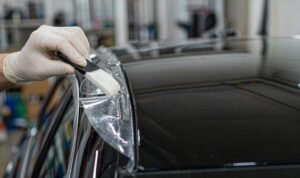
A wrapped edge carries the film around the physical edge of the panel and terminates it on the back side — out of sight, out of the airflow, and out of the wash lance’s path. Doing it properly needs 3 to 6 millimetres of surplus margin, patient post-heating at 90 to 100 degrees C to lock the tuck, and often removal of the bumper, headlights or mirror caps, at 30 to 60 minutes of disassembly each. It is the only termination that leaves nothing for a fingernail to catch. This is what separates a premium TPU PPF installation from a template-only one — TPU PPF behaves identically in both cases; the edge work is what you are paying for.
What each method costs in hours and risk
Labour runs 35 to 55 percent of any PPF invoice, and the edge policy decides where those hours land. Pattern-only installs finish a full front in 6 to 9 hours and deliver identical results every vehicle. Extending patterns and wrapping edges adds roughly 1 to 2 hours. True hand-cutting — bulk film laid on the panel and trimmed to the actual edge in front of the installer — adds 1 to 3 hours on a full front, and shops that run it as standard price full-car work at 8,000 to 10,000 dollars once correction and coating are in the package.
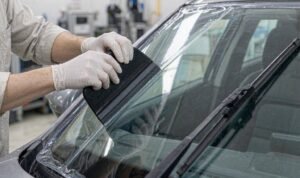
The unquoted cost is blade risk. Every metre trimmed on the car is a metre where the blade can score clear coat: one pass cuts 5 to 15 microns into paint whose factory clear layer is only 35 to 55 microns thick. Near window surrounds, a slip can score the glass — a weak point that may crack under thermal stress — or nick a rubber seal and convert itself into wind noise and a water leak. So the honest answer to “hand-cut or plotter” is not that one is universally better; it is that the blade protocol matters as much as the method. Knifeless tape at panel seams, a fresh blade per panel, and a hard card as a cutting guide keep steel off paint entirely.
Exposed edges fail on a schedule you can calendar. A cut edge collects wax, polish and soot within 2 to 6 weeks — the dirt line. Pressure washing against a raised lip drives water under the adhesive, and lift follows; the mechanics are the same as in why PPF edges lift within 90 days. And at highway speed, a 1-millimetre shelf of exposed film sits in the airstream as a permanent wedge working at the bond.
Put the edge in writing before the film leaves the box
Step 1. Ask the edge policy in millimetres: do the patterns stop short of the edge, by how much, and are edges wrapped or cut? A shop that answers in numbers is a shop that has made a decision.
Step 2. Ask what gets disassembled. Bumper, headlight and mirror-cap removal adds half a day but buys the access real wrapping requires.
Step 3. Ask for the blade protocol: knifeless tape at seams, fresh blade per panel, no blade riding on paint.
Step 4. Confirm the finishing standard: 3 to 6 millimetres tucked and post-heated at 90 to 100 degrees C, so the tuck stays down through wash cycles.
Step 5. Walk the delivery check together: run a fingernail along ten edge points, view the car at one metre under bright light, and get the wash rules in writing — no pressure jetting at edges for the first two weeks.
If any of this feels familiar, it should: the same logic separates a real coverage spec from a loss-leader, as in what a 599-dollar full front PPF quote actually includes. The quote document is where a car film supplier either earns the job or hides from it.
| Ask | Why it matters | Acceptable range |
|---|---|---|
| Edge inset | Dirt line and exposed paint on the leading edge | 0 mm if wrapped; 2 mm max if cut |
| Relief cuts | Bare paint left at high-impact corners | None on show face; cuts hidden behind seams |
| Disassembly | Access needed to wrap edges properly | Bumper, headlights and mirror caps on a full front |
| Blade protocol | Clear coat scoring is irreversible | Knifeless tape, fresh blade per panel |
| Post-heating | Keeps the wrapped tuck adhered | 90 to 100 degrees C on every wrapped edge |
| Delivery check | Catches faults while they are free | No fingernail catch at 10 edge points |
The same SUV, two quotes, thirty months
Quote A: 1,950 dollars, plotter patterns with the default 2-millimetre inset along roughly 9 linear metres of leading edge, relief cuts left open at four corners. Quote B: 2,650 dollars, patterns extended, edges wrapped, bumper and lights off, about 2.5 hours more labour.
At eight weeks, A’s owner returns with a dirt line along the hood and soot in two headlight notches: a 120-dollar detail wash, then 95 dollars to re-press three edges. At month 14, two corners lift after a winter of automatic washes — patch and press, 340 dollars. Total spend lands at 2,505 dollars, and the car still shows a line visible at two metres.
B ran the same thirty months with zero callbacks and no visible edge anywhere. The 145-dollar difference between the quotes was spent once, on millimetres, and it is still on the car — and on the invoice when the vehicle is resold.
An edge you can find with a fingernail is an edge that will find your wallet later. Pay for the millimetres once, in writing, before the film comes out of the box.