The quote that looked twice as good
A distributor in the Gulf gets two data sheets in the same week. Supplier A: “QUV 2,000 hours, ΔE < 2.0.” Supplier B: “Xenon 1,000 hours, Δb* < 2.0.” On paper, A looks like twice the film, at 8% less per square metre. The order goes to A.
Fourteen months later the first complaint lands: bonnets on white SUVs reading yellow at the edges, haze visible in low sun. The film did not fail because the test was fake. It failed because “2,000 hours” described a different stress than the one the car actually sees, and nobody asked what lamp was in the chamber.
Hours are a unit of time. They are not a unit of stress. Two labs can both run “1,000 hours” and deliver 2.5 times different UV dose, at different panel temperatures, with different wet time, scored against a different endpoint. Until you know those four things, the hour count on a TPU PPF film data sheet is marketing, not durability.
Four numbers behind every hour count
1. The lamp
Fluorescent UV cabinets (ASTM G154, ISO 4892-3) run either UVA-340 lamps, which match sunlight from roughly 295 to 360 nm, or UVB-313 lamps, which emit below the terrestrial cut-off. UVB-313 shortens a test dramatically and produces failure modes that never occur on a car roof. If a sheet says UVB-313, treat the hours as a screening number and nothing more.
Xenon arc (ASTM G155, ISO 4892-2, SAE J2527) runs a filtered full spectrum, about 300 to 800 nm, including the visible and near-infrared that drive heat build-up and pigment shift. Automotive exterior parts are normally qualified on xenon for that reason. A UVA-340 cabinet is excellent for ranking two formulations against each other; it is weaker at predicting colour movement, which matters most if you sell colour film rather than clear.
2. Irradiance
The set point matters as much as the clock. The common G154 cycle runs 0.89 W/m²/nm at 340 nm. SAE J2527 runs 0.55 W/m²/nm at 340 nm. Per clock hour, the G154 chamber delivers about 1.6 times the UV energy, so 1,000 hours there carries roughly the dose of 1,600 hours on J2527, before cycle, temperature or endpoint are considered.
Ask for irradiance, then convert everything to dose. Irradiance multiplied by hours is the only comparison that means anything.
3. Cycle and black panel temperature
A standard G154 cycle is 8 hours UV at 60°C black panel, then 4 hours condensation at 50°C. J2527 typically runs 3.8 hours light at 89°C black panel, 50% relative humidity, then 1 hour dark with spray. Those are not equivalent: 89°C accelerates oxidation and adhesive creep far more than 60°C, and the spray-and-dark step adds the thermal shock a condensation-only cycle never reproduces.
Wet time decides whether you are testing UV or testing hydrolysis. Failures in humid and coastal markets are frequently moisture-driven; the ester segments in the soft segment break down and the film blisters from the inside. A dry-only cycle will not find that, whatever the hour count says.
4. The endpoint
“ΔE < 2” means nothing without the formula, the illuminant and the geometry. ΔEab and ΔE00 differ by 30 to 50% on the same pair of readings. Δb tracks only the yellow-blue axis, which is the right metric for clear TPU PPF and the wrong one for a colour film. Haze (ASTM D1003) and 60° gloss (ASTM D523) catch degradation that colour misses: a film can hold ΔE 1.5 while its topcoat has fallen from 92 to 78 gloss units and looks dull under showroom light.
Then ask where the reading was taken. Edges and stretched zones age faster than panel centres. A sheet quoting one ΔE for a whole panel is quoting its best area. This is also why a value-tier TPH PPF film can post a respectable number: the report was measured where the film was flat and unstressed.
| What to ask | Why it matters | Pass range |
|---|---|---|
| Lamp type and standard | UVB-313 over-accelerates; UVA-340 ranks formulations; xenon predicts real exterior colour shift | UVA-340 (G154) for screening, xenon (G155 or SAE J2527) for anything you will warrant |
| Irradiance at 340 nm | Converts hours into dose; a 1.6x difference hides inside the same “1,000 h” | 0.89 W/m²/nm (G154) or 0.55 W/m²/nm (J2527), printed on the sheet |
| Cycle, panel temperature, wet phase | Heat drives oxidation and adhesive creep; wet time drives hydrolysis | 60-89°C black panel with a condensation or spray phase, not a dry-only cycle |
| Endpoint metric and formula | ΔE00, ΔEab, Δb, haze and gloss answer different questions | Δb* ≤ 2.0 and ΔE00 ≤ 2.0 at 1,000-2,000 h xenon; haze gain ≤ 1 point; gloss loss ≤ 5 GU |
| Where readings were taken | Edges and stretched areas fail first; panel centres flatter the film | 5 points per panel, at least 50 mm from edges, plus one stretched coupon |
| Who ran the test | In-house screening panels are not third-party reports | Accredited lab, report number, dated within 24 months |
How to check a claim in one afternoon
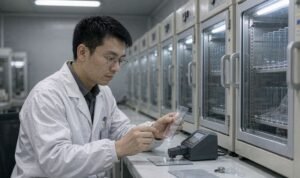
Step 1. Ask for the full report, not the summary line: lamp, irradiance, cycle, black panel temperature, endpoint, panel count, lab name.
Step 2. Convert both suppliers onto one axis. Multiply irradiance by hours and write the dose next to each claim before you compare anything else.
Step 3. Run your own 500-hour coupon test on the two films you are actually choosing between. 100 × 100 mm coupons, G154 UVA-340 at 0.89 W/m²/nm, 8 hours light at 60°C, 4 hours condensation at 50°C. Include one coupon stretched 20% to mimic a bumper shoulder.
Step 4. Measure before and after: Δb* at D65/10°, haze by D1003, 60° gloss by D523, and 180° peel by ASTM D3330. Four numbers, one lab slot, roughly USD 300-600 depending on market.
Step 5. Compare peel retention, not just colour. A film that holds its colour but loses 40% of its adhesion has already failed; it simply has not lifted yet.
Step 6. Write the accepted values into the purchase order. “Δb* ≤ 2.0 after 1,000 h SAE J2527, third-party report within 24 months, 5 measurement points per panel” is a clause a supplier can accept or decline. “QUV 2,000 h” is not a clause at all.
The case
A sunbelt distributor with 60 rolls on order, about 1,370 m² and USD 16,000 landed, ran the 500-hour coupon test on two finalists before releasing the second container.
Supplier A, the one quoting 2,000 hours: the report was UVB-313 at 0.71 W/m²/nm, black panel 60°C, dry cycle only, endpoint ΔEab on a white panel. On the distributor’s own UVA-340 coupons the same film read Δb 2.9, haze up 1.8 points, gloss down 11 GU, peel retention 61%. At 500 hours.
Supplier B, quoting 1,000 hours xenon: Δb* 1.0, haze up 0.4, gloss down 3 GU, peel retention 88%.
The order moved to B at 6% higher film cost, about USD 960 more. A’s first container had already gone to two installers; those 22 rolls produced 9 warranty complaints in 15 months, mostly bonnet edges plus one full bumper redo at USD 640 in material and labour. The distributor’s own estimate of exposure before labour credits was USD 4,100. The test cost USD 480.
The line to hold
If a supplier can only tell you how many hours, they have not told you anything yet. Ask what was in the chamber, at what dose, at what temperature, measured how, and put the answer in the purchase order, because that is the only part of the conversation that survives a warranty claim.