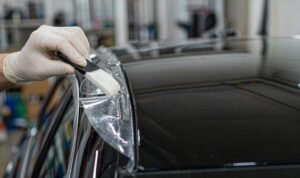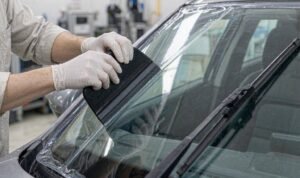
A three-week-old SUV comes in for a quote on the rest of the car. The dealer sold the owner “full front PPF” for 2,050 USD inside the finance package; now he wants rockers, rear bumper and roof edge done. The installer glances at the hood, sees film, and quotes a top-up.
Then he puts the gauge on it. Total reading on the hood: 158 microns. Bare door jamb on the same car: 96. That is 62 microns of film, not the 190 to 215 a 7.5 or 8.5 mil TPU film should show — premium package money for a thin film with flush-cut edges already grey with dirt. The top-up quote is now a strip-and-redo conversation, and the shop is the one explaining it.
This is routine in 2026. Automakers and dealer groups are pushing film as a finance-office add-on, and the film arriving on those cars is not what an independent shop would sell. You cannot quote around unknown film: you audit it, in writing, before the car enters the bay — twenty minutes, four numbers.
Coverage Is Square Metres, Not an Adjective
“Full front” means nothing on a dealer invoice. On a mid-size SUV, a genuine full front — complete hood, both full fenders, full bumper, mirrors, headlights — runs 3.2 to 3.8 square metres of film. A half front or impact-zone package is 1.6 to 2.2 square metres: hood to the first third, fender leading edges only, and a bumper strip that stops below the grille.
The bumper is where this matters. The bumper cover and the leading 300 mm of the hood take most of the chip energy, and dealer kits routinely leave the upper bumper and the plate surround uncovered because those shapes are slow to install. Ask for the coverage map, then walk the car piece by piece. Count seams: every pre-cut kit has gaps at panel edges, and each gap is bare paint.
Thickness Tells You What Was Actually Sold
An ultrasonic coating gauge that reads over steel is the cheapest audit tool a shop can own. It reads total dry film — paint plus film — so you need a bare baseline from an unfilmed panel on the same car: door jamb, inside the tailgate shut, under the sill. Subtract, and you have film thickness at that point.
Reference values: a nominal 7.5 mil film measures roughly 190 microns, 8.5 mil about 215, and the 6 mil films that turn up in cheap dealer kits land near 150. Because ASTM D374 allows plus or minus 10 percent on nominal thickness, a 190 micron film can legitimately read 171. One reading proves nothing. Take five points per panel — centre, two corners, two edges — and use the median. A median of 172 on a car sold as 8.5 mil is not tolerance, it is a different product.
Two traps. Ultrasonic gauges will not read through a plastic bumper cover, and half the film on a car sits on plastic: use a film gauge with the right probe, or caliper an offcut. And repaint hides in the total — 180 microns of paint under a 190 micron film reads 370 while the film is fine.
Edges and Cuts Decide Whether the Film Survives
Wrapped edges separate a ten-year install from a two-year one, and they are visible in seconds. A finished edge carries the film 3 to 6 mm around the panel and behind it, so you cannot see the film line from outside. A flush cut stops at the edge, where adhesive sits exposed to wash water and every towel wipe.
Then look at the cuts. Pre-cut dealer kits leave 5 to 10 mm of uncovered margin around emblems, handles and sensor bezels, and the gap between two kit pieces at a shut is normally 0.5 to 2 mm. That is where lifting starts, because the film has no purchase on the curve. Under a 10x loupe at 1,000 to 1,500 lux raking light, blade tracks in the clear coat also appear — evidence the film was trimmed on the car, a paint repair you inherit the blame for.
Paperwork Is Half the Product
Dealer film usually carries a dealer warranty, not the film maker’s, and those are different instruments. Ask for three things: film brand and product code, registration confirmation in the owner’s name, and the invoice line showing what was sold. Several manufacturers now refuse any claim without online registration at installation, so an unregistered car effectively has no warranty. Your workmanship warranty covers your labour, not film you did not install — put that exclusion in the quote before the first squeegee stroke.
The Audit Table to Keep at the Front Desk
| What to ask | Why it matters | Passing range |
|---|---|---|
| Film area in square metres per panel | “Full front” is marketing, not a measurement | Full front 3.2-3.8 m²; half front 1.6-2.2 m² |
| Film thickness, median of 5 points | Reveals 6 mil sold as 7.5 or 8.5 mil | 7.5 mil 185-210 micron; 8.5 mil 205-230 (ASTM D374, ±10%) |
| Edge finish at hood, fenders, bumper | Flush cuts fail at the edge first | Film wrapped 3-6 mm behind the panel, no visible line |
| Gap width between kit pieces | Gaps are bare paint and lift initiation points | 0.5-2 mm at shuts, none within 10 mm of a convex curve |
| Cut quality on the car | Blade tracks become your liability | No scratch visible at 10x under raking light |
| Registration in the owner’s name | Unregistered film has no enforceable claim | Confirmed in writing, 15-30 days from install |
The Twenty-Minute Procedure
Step 1: Intake under controlled light. Kill the overheads, inspect with a handheld at 1,000 to 1,500 lux held low, and photograph every panel with the film edge in frame. Eight to twelve photos become the record if the owner later blames your work.
Step 2: Draw the coverage map. Sketch the car, shade what is covered, write square metres beside each panel — before you quote.
Step 3: Establish the paint baseline. Three readings on an unfilmed panel, then five per filmed panel; record the median. On plastic, caliper an offcut or mark the number unverified.
Step 4: Inspect edges and cuts. Hood leading edge, four fender edges, bumper returns, mirror caps, door edges. Note every flush cut and every gap.
Step 5: Photograph the invoice line, the registration confirmation, and the roll label if one is still in the glovebox.
Step 6: Choose one of three routes and say which out loud. Top up around good film. Strip and redo where film is thin, flush-cut or unregistered. Or decline and hand the owner the audit — a car with failing dealer film produces a complaint in eighteen months, and it lands on whoever touched it last.
What the Numbers Did on Two Cars
Car one: dealer “full front, 8.5 mil” at 2,050 USD. Measured coverage 3.1 square metres, hood median 172 microns, three of four fender edges flush-cut, one mirror cap unwrapped. Verdict: strip 2.1 square metres of hood and bumper and redo with a real 8.5 mil Clear TPU PPF. The customer paid 780 USD more than the top-up quote he walked in for; the dealer called the film “within standard.”
Car two, same dealer group, different store: coverage 3.6 square metres, hood median 207 microns, all edges wrapped 4 to 5 mm, registration confirmed in the owner’s name. Nothing to strip. The shop sold a 2.6 square metre top-up on rockers and rear bumper at 640 USD and kept the front. The audit took 18 minutes and protected a job instead of killing it.
The difference is not skill. It is 22 minutes with a gauge, a light and a printed table — the discipline a TPU PPF program applies to incoming rolls, pointed at a finished car. Installers who already argue whether thicker film stops more chips are halfway there. The rest is accepting that the film on the car, not the film in your rack, sets the price.
The Position
Quote the car in front of you, not the package on the invoice. If you cannot put a thickness number and a coverage number against every panel, you are not quoting a job — you are guessing at somebody else’s work, and the film you did not install is the film you will be blamed for.
Proving what you bought is a separate discipline from installing it, and it starts with a TPU PPF film supplier that prints its tolerances and stands behind the number.