The Combo Quote That Sounded Too Good
A customer walks in and asks for the setup everyone saw at the trade shows this year: full protection underneath, a color change on top. Your shop quotes clear TPU PPF on the whole car, then a satin black wrap over it, and the invoice lands near eight thousand dollars. Fourteen months later the customer is back, pointing at lifted edges along the door skin, asking which layer failed and who pays. The installer blames the vinyl. The vinyl distributor blames the film underneath. The film distributor, who never agreed to have anything laminated on top of his product, quietly checks his warranty terms.
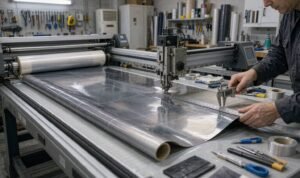
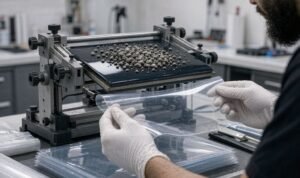
This stack is real and it is growing, because it does something no single product can: rock-chip protection on the original paint plus a reversible color change on top, which is exactly what lease drivers and picky owners want. Shops are charging two thousand dollars or more extra for the combination, and plenty of customers say yes. What almost nobody says out loud is that stacking two pressure-sensitive adhesive systems creates a set of predictable problems, and that both manufacturers’ warranties may have a clause about it. Here is what to check before you sell the combo.
Four Dimensions That Decide Whether the Stack Survives
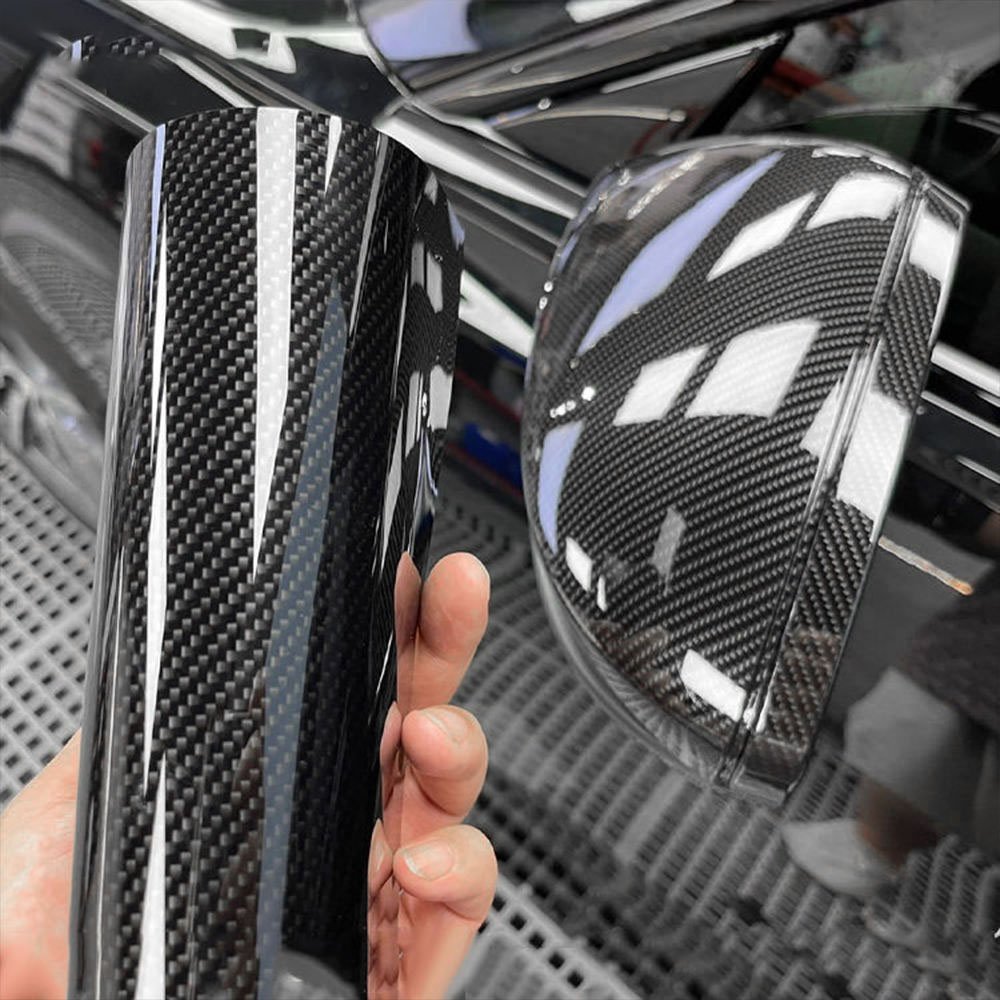
1. Surface energy and adhesive compatibility. Vinyl wrap adhesives in every mainstream Car Wrap Vinyl line are engineered for factory paint, which typically presents a surface energy around 38 to 42 millinewtons per meter. A urethane top coat on protective film often sits lower, commonly in the 30 to 34 range, because that chemistry is designed to shed contaminants. Lower surface energy means weaker wet-out and a shorter reliable edge hold, especially on films with a slick or fluorinated top coat. Some vinyl makers publish approval for application over other films; many simply do not address it. Medium-tack cast films with air-egress channels are the only reasonable candidates for this job, and a test panel on the actual film should be part of every quote.
2. The warranty cross-check. This is the part peers avoid saying plainly: several film manufacturers limit or void coverage when their film is covered by another laminate, because the vinyl blocks inspection and changes UV and heat exposure at the surface. On the vinyl side, warranties routinely exclude failures caused by the substrate, which a film absolutely is. Before you sell the stack, get both positions in writing, in an email you can file. Verbal assurances at a trade show booth are not a claims strategy.
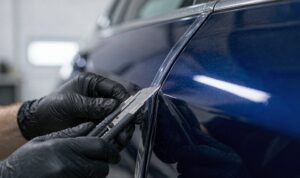
3. Edge geometry under vinyl. A properly installed film wraps edges by 3 to 6 millimeters, which creates a visible step in surface height. Vinyl laid over that step bridges it under tension, and the bridged line becomes the lift line. The fix is planning, not luck: either keep vinyl seams and cuts at least 10 to 15 millimeters away from every film edge and seam, or accept that the vinyl over a film edge is the first place to inspect at every check-up. Panels where film was cut tight to body lines need extra attention.
4. The five-year money math. Run the honest comparison before quoting. A stacked build might be 3,500 to 5,500 dollars for the film layer plus 2,000 to 3,500 for the vinyl and prep, with the vinyl expected to be removed and redone every 3 to 5 years at 1,500 to 2,500 dollars per cycle, since removing car wrap vinyl over film is slower and more cautious than removal over paint. A Color TPU PPF build is typically 4,000 to 8,000 dollars once, with an 8 to 10 year service life and no second layer to maintain. The stack wins when the customer wants to change colors repeatedly while keeping the protection layer; it loses as a one-shot color decision.
| What to ask before quoting the stack | Why it matters | Acceptable range or answer |
|---|---|---|
| Film maker’s written position on over-lamination | Decides whether the warranty survives the combo | Written approval or explicit exclusion on file |
| Vinyl maker’s substrate coverage | Vinyl claims depend on what it was applied to | Film listed as approved substrate, in writing |
| Vinyl adhesive class | Low-tack films over slick top coats lift early | Medium-tack cast, air-egress, test panel passed |
| Distance of vinyl cuts from film edges | Bridged film edges are the lift lines | 10-15 mm clearance minimum |
| Cure time before wrapping | Fresh film off-gasses and shrinks slightly | 5-7 days after film install, minimum |
| Removal plan for the vinyl layer | Removal over film needs different technique | Scheduled cycle and quoted removal cost on the invoice |
How to Install It So It Lasts
Step 1. Get the paperwork first. Written positions from both manufacturers, filed with the job folder. If either brand excludes the combination, tell the customer and let them sign an acknowledgment. That page costs nothing and has saved shops from exactly the argument in the opening story.
Step 2. Let the film cure. Five to seven days between film install and vinyl install, minimum. Adhesives continue cross-linking and the film sheds its last bit of shrink in the first week. Wrapping on day two locks in a substrate that is still moving.
Step 3. Prep the top coat, not the paint. Isopropyl wipe at roughly 1:1, lint-free cloths, and a clay pass only if needed. Do not abrade the film top coat to “help adhesion”; you are removing your polish budget to fix an adhesive problem that better product selection should solve.
Step 4. Plan cuts away from film edges. Wherever possible, finish vinyl cuts on flat film field, 10 to 15 millimeters from every film edge, seam, and relief cut. Where a cut must cross a film edge, post-heat that section at 90 to 100 degrees Celsius for 10 to 15 seconds per 100 millimeters and press firmly to seat the adhesive.
Step 5. Log the baseline. Record 60-degree gloss and a photo set of every film edge under the vinyl perimeter. If a dispute starts at month ten, the baseline is the difference between a warranty claim and a he-said discussion.
A Real Build, With Numbers
A coupe came in for the full stack: clear film at 3,900 dollars, satin vinyl at 2,300 dollars, 28 hours of labor at 80 dollars an hour, total near 8,400 dollars. The shop followed every step above, including a written film-brand acknowledgment and a 6-day cure. At the 14-month inspection, two small lifts at vinyl cuts that crossed film edges on the rear bumper were re-seated in 40 minutes under warranty labor; every other edge was tight. The same build done without cure time and with cuts landed on film edges, as a competitor’s job was, showed nine lifted points at month ten and a 600-dollar rework bill. The stack is not fragile by nature. It is fragile by shortcuts.
The Stance
The PPF-under-vinyl stack is a legitimate product and a good margin story, but it is also the only job on the price list where two manufacturers can both be right while the shop is wrong. Sell it with the warranty cross-check in writing and the edge plan on paper, or sell the customer a single-layer Color TPU PPF instead and keep the five-year math simple.