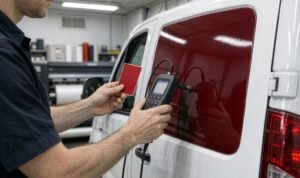
A customer calls eighteen months after a full front-end job. The hood no longer beads. Rain sits on it in flat, grey sheets, the water spots dry into rings, and he has already decided the shop installed a cheap film. He wants a re-wrap under warranty. The owner, wanting to keep the account, approves a new hood panel out of pocket. Three weeks later a detailer runs an isopropyl wipe across the old panel and the beading comes back within minutes. The film was never dead. It was filthy, and the shop paid for a diagnosis it never ran.
Scenes like this play out every month, and both sides lose. The installer eats a panel he did not owe. The customer drives away convinced that TPU PPF quietly dies inside two years. The deeper problem is that almost nobody in this trade teaches the difference between a top coat that has failed and a surface that has been contaminated, because settling that question honestly forces harder conversations about maintenance, water quality, and what a hydrophobic finish actually promises. Here are the numbers that settle them.
Four Measurable States, Not One Vague Complaint
“Water stopped beading” is a symptom, not a diagnosis. Before anyone touches a claim form, the film’s condition has to be pinned down along four independent dimensions. Each one has an accepted test method and an accepted range, and each one points at a different failure owner: the customer’s wash habits, the water supply, the film itself, or the installer’s aftercare briefing.
Dimension 1: the water contact angle. A healthy top coat is a low-surface-energy layer, and water reads its condition for free. Fresh film beads at a contact angle of roughly 100 to 115 degrees, which the eye sees as tight, near-spherical droplets. As the top coat erodes, or as bonded contamination builds up on it, the angle drops. Below about 80 degrees the droplets flatten and water starts to sheet. The trap is that a worn-out top coat and a hood caked in iron fallout and hard-water minerals produce the same visual. Sessile-drop measurement per ASTM D7334 or D5946 on a cleaned panel is the only way to know which one you are looking at.
Dimension 2: color difference, expressed as delta b-star. Yellowing lives in the base film, not the top coat, and it is tracked on the CIE L-a-b scale with a b-value per ASTM E313. Across the first five warranty years, an aliphatic film should stay within roughly 2 points of its baseline. A panel that has drifted more than 3 points while also losing its beading is telling you the polymer itself is oxidizing, which is a material problem and a legitimate warranty conversation. A panel that beads poorly but shows a delta b-star under 1 is telling you the opposite. If yellowing and beading loss show up together, run a structured check the way we laid out in our guide to catching TPU PPF yellowing early before you write the claim.
Dimension 3: haze. Measured against ASTM D1003, a new film runs between 0.6 and 1.5 percent haze. Growth beyond about 2 points over the installed life is optical degradation, and unlike dull beading it is visible on the car from two metres away. Haze plus yellowing together is the classic signature of bulk film failure. Haze alone, with color stable, usually means the top coat has been scoured by automatic brush washes.
Dimension 4: the recovery tests. These are the cheapest and most decisive. Wipe a test area with isopropyl alcohol diluted one to one with water, let it dry, and drip water on it again. If beading returns, the top coat is alive and something was sitting on it. Then take a light wash-mark or scuff, warm the panel to 50 to 60 degrees with warm water or a heat gun on low, and watch. If the mark fades in minutes, the elastomer layer is still functioning. A surface that fails both recovery tests, on a panel that also shows high delta b-star and rising haze, has a genuinely consumed top coat.
The Triage Table Worth Taping to the Bench
| What to test | Why it matters | Pass range |
|---|---|---|
| Contact angle after wash and decon | Separates contamination from top coat wear | 100 degrees or more when new; under 80 after proper cleaning means top coat failure |
| Delta b-star versus baseline | Separates surface dullness from bulk yellowing | Within 2 points through year five; over 3 supports a material claim |
| Haze per ASTM D1003 | Optical death is claimable; dull beading alone is not | New film 0.6 to 1.5 percent; growth over 2 points is failure |
| IPA wipe, then retest beading | Ten-minute triage: contamination or permanent loss | Beading returns means contamination; no change means consumed top coat |
| Heat at 50 to 60 degrees on a scuff | Confirms the self-healing layer is still alive | Marks fade within minutes; persistent marks mean the elastomer is gone |
Running the Test in the Bay
Step 1: establish a clean baseline. Wash with a pH-neutral shampoo, treat the panel with an iron remover, clay it, and dry. Half the “dead film” cases end here, because the beading returns before you ever measure anything. On a quality Clear TPU PPF, a properly decontaminated hood should tighten right back up.
Step 2: drip-test the hood and a door under the same conditions. Horizontal panels take ultraviolet load and contamination far harder than vertical ones, so a hood that beads worse than the doors is normal wear. A door that beads as badly as the hood is a warning.
Step 3: run the IPA wipe on one 30-centimetre square of the worst panel. Dilute one to one with water, wipe with a folded microfiber, wait five minutes, and repeat the droplet test. Note the change.
Step 4: heat one section. Warm water at 55 degrees or a heat gun kept moving is enough. Watch whether wash marks disappear and whether the beading tightens.
Step 5: read the combination. Beading restored after decon and IPA means maintenance, not material. Beading restored on the doors but not the hood, with color stable, means the horizontal top coat is wearing early, and a ceramic topper is the honest fix. No recovery anywhere, delta b-star above 3, haze up more than 2 points, and you have a claim worth filing, with measurements instead of opinions attached.
A Case With Numbers
A 2024-wrapped sedan came back with the complaint described above. Measured after a standard wash: the hood beaded poorly, contact angle around 58 degrees, while the doors held at 103. Delta b-star measured 0.6 against the installer’s baseline. Haze read 1.1 percent. After the IPA wipe the hood returned to 96 degrees, and after an iron treatment it sat at 101. Verdict: bonded ferrous contamination and hard-water minerals, not film failure. Cost to the shop: twenty minutes and a bottle of iron remover. The customer left with a maintenance card instead of a warranty dispute.
A second car told the opposite story. No recovery after IPA and heat on any panel, delta b-star up 3.4, haze up 2.6 points, uniform across hood and doors at only three years. Every line of the table pointed at bulk degradation. That claim was filed with the five measurements attached, and it was honored, because numbers survive the argument that adjectives never do.
The Uncomfortable Summary
Most hydrophobic failures on any car paint protection film are maintenance debts, not material defects, and a shop that can prove it in ten minutes with an IPA bottle keeps both its margin and its reputation. The ones that cannot measure will keep buying hoods for customers who never maintained anything.