Two menus, one bay, no answer
A dealer adds three items to the delivery menu: a roof wrap, a chrome delete, a full front PPF job. The finance office likes all three because they lift gross profit per unit, and dealer accessory programmes are the fastest growing part of the film business at roughly 10 percent a year. Eighteen months later the wrap bay is booked five weeks out, the PPF installer idles two days a week, and nobody can say which of the three earned its space.
The arithmetic was never done. Almost every shop measures add-ons by revenue per car, or by margin percentage, and both numbers flatter the slow job. A 45 percent margin on a five-hour roof looks better than a 32 percent margin on a two-and-a-half-hour tint until you divide by the hours.
The only scarce thing in the building is the bay hour
Labour is 55 to 70 percent of a retail wrap invoice. The film is not what limits you. The bay is. Once you accept that, every add-on has one comparable number: gross profit per bay hour, after film, consumables and a warranty reserve.
Gross profit per bay hour equals retail price minus film cost, minus consumables, minus a reserve for comebacks, divided by every hour the job occupies the bay, including prep, disassembly and quality check. Not the hours on the invoice. The hours on the clock.
That change of denominator reorders most menus, which is why dealers optimising profit per unit and installers optimising hours per job keep arguing past each other.
Four inputs you have to measure, not guess
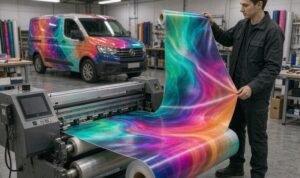
1. Film cost per vehicle, from roll yield. A standard roll is 1.52 by 15 metres, 22.8 square metres. A roof plus a chrome delete consumes 3.2 to 3.8 square metres once you allow 15 to 25 percent waste on curves and overlaps. A full front PPF job takes 4 to 5 square metres, a full wrap 18 to 24. Price per square metre in 2026 runs roughly 6 to 12 dollars for cast vinyl, 18 to 30 for color TPU PPF, 12 to 20 for clear film, and 40 to 120 dollars per car for ceramic tint. Quote from the invoice total instead of square metres consumed and you will underprice every compound curve.
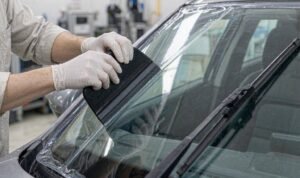
2. Hours, measured with a stopwatch. Full front PPF is 6 to 9 hours depending on sensors and bumper geometry. A roof wrap with chrome delete is 4 to 6. A full-car ceramic tint is 2 to 3. A full wrap is 18 to 30, which is why it is one to three days of a bay. Dry-apply systems claim 1.5 to 3 hours off a full PPF job, and in most shops that claim holds.
3. The retail ceiling in your market. In the United States this year, full front PPF runs 1,100 to 3,000 dollars with a median near 2,000, full body PPF 3,500 to 10,000, a colour-change car wrap vinyl job 2,500 to 6,000, colour PPF 6,000 to 10,000, and a full-car ceramic tint 250 to 700. Substitute local numbers but keep the ratio: film is a quarter to a third of the ticket, labour is the rest.
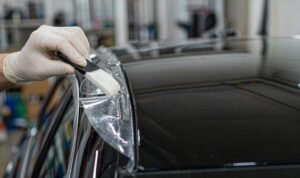
4. Comeback rate and warranty reserve. Budget 3 to 5 percent of add-on revenue. Wrap edge lift appears on 3 to 8 percent of jobs within twelve months, mostly on horizontal panels. PPF edge lift sits under 2 percent when edges are post-heated at 90 to 100°C.
The numbers to put on one page
| What to ask | Why it matters | Acceptable range |
|---|---|---|
| Film cost as a share of retail | Shows whether the SKU is priced or just marked up | 20–35% of the ticket |
| Quoted hours versus clocked hours | The hidden loss in every menu | Within 10% on the last five jobs |
| Gross profit per bay hour | The only comparable figure across SKUs | ≥2.5× loaded bay cost, roughly 110–200 USD |
| Comeback rate, first 12 months | Converts quality into a per-job cost | ≤5% of jobs, ≤3% for PPF |
| Attachment rate at delivery | Tells you if the problem is capacity or selling | 15–35% on a three-item menu |
| Warranty exposure on the panel you cover | A roof claim costs more than a door claim | Horizontal panels covered, not excluded |
Build the ranking in six steps
Step 1. Stopwatch five jobs per SKU. Include prep, badge and handle removal, and the final inspection. Throw away the fastest one, it was a good day.
Step 2. Record square metres consumed per vehicle from the roll, not the invoice. Track waste for a month; the true number is higher than the one in your head.
Step 3. Set a floor before you look at the results. A common floor is 2.5 times loaded bay cost, which in most US and Western European markets lands between 110 and 200 dollars an hour.
Step 4. Rank by gross profit per bay hour and mark everything below the floor. Keep a below-floor item only if it reliably pulls a higher-value job with it, and say so out loud.
Step 5. Decide which constraint you have. If bays are full, cut the low-yield SKU. If bays are empty, that SKU is a conversion tool, not a profit centre, and should be priced like one.
Step 6. Re-run the model every quarter. Unbranded coloured TPU wholesale prices fell 25 to 40 percent between 2023 and 2025, and film cost per vehicle is the line that moves most.
One dealer, one bay, two menus
Sixty units a month, one bay, 160 productive hours.
Menu A was roof wrap plus chrome delete at 1,250 dollars: 250 of film, 80 of consumables, 7.5 hours. Gross profit 920 dollars, or 123 per bay hour. At 28 percent attachment, 17 jobs a month, 127.5 hours, 15,640 dollars.
Menu B was full front PPF at 1,850 dollars: 420 of film, 70 of consumables, 7.5 hours, 1,360 gross, 181 per bay hour. Plus ceramic tint at 480: 110 of film, 2.5 hours, 340 gross, 136 per hour. At 22 percent PPF attachment and 40 percent tint attachment, 13 PPF jobs and 24 tint jobs, 157.5 hours, 25,840 dollars.
Same bay, same month, 10,200 dollars apart. Menu B also needs a certified installer, two to three days of training at 1,500 to 3,000 dollars, and a bay that can hold cleanliness. At this volume it pays back in two months.
The wrap menu is not simply worse, and pretending otherwise is how consultants lose clients. A roof is visual. Customers decide on it in the showroom in four minutes, while PPF is an invoice conversation the finance office has to win. Attachment rate, not profit per hour, is what the wrap buys.
The wrap math also has one free lever: batching. Three roofs in a day share setup, masking and cleanup, and 7.5 hours drops to 5.8 to 6.2, lifting the same job from 123 to 148–158 per bay hour. Batching is the only improvement here that costs nothing.
The clause that decides whether the add-on is real
Read the warranty on the panel you cover. Most colour-change warranties run three to five years on vertical panels and exclude or shorten horizontal ones, so the roof is precisely the surface the warranty does not want to hear about. A roof wrap is therefore the highest claim exposure per dollar of gross profit on the menu.
PPF warranties are longer, commonly ten years on material, but usually require registration within 15 to 30 days of installation and exclude commercial and fleet use more often than buyers expect. If the paperwork is not done at delivery, the customer owns film with no coverage and the dealer owns the conversation.
That is the test for any fourth item: can it survive its own warranty on the panel it covers? The five-year cost comparison between colour PPF and vinyl shows how quickly a cheap wrap becomes an expensive one.
The add-on worth selling is not the one with the best margin percentage or the highest ticket. It is the one that still makes money in month thirty, when the car film is out of warranty, the customer remembers who sold it, and the bay hour has been paid for twice.