A distributor in a coastal market ordered a container of what the invoice called premium aliphatic TPU film, priced roughly 40 percent below the brand he normally stocks. The first thirty installs looked clean. Around month five, customers started returning with a yellow cast across hoods and roofs, and two cars developed blisters along the lower doors. When he asked for batch test reports, the supplier sent a PDF for a product name that did not match the label on his boxes. By month eight he had eaten the re-do labor on eleven vehicles and quietly switched suppliers, with nothing in writing to support a claim.
That is how counterfeit and re-branded película de proteção da pintura actually costs money. Not at customs, not at unboxing, but months later, when the failure shows up on a customer’s car and the paperwork trail leads nowhere.
Why fake film keeps finding buyers
Market analyses of the PPF category keep flagging counterfeiting as a trust problem, and the mechanism is simple. Real aliphatic TPU film carries a high raw material cost, so anyone selling far below market has to be cutting somewhere: thinner base film, aromatic TPU blended in, a topcoat without real UV stabilizers, or a cheaper pressure-sensitive adhesive. None of that is visible on the day of installation.
What makes it worse is that the industry’s own success created cover for fakes. Buyers have learned to ask for “a 10-year warranty,” and counterfeiters print those words on a box as easily as anyone else. A warranty is only as real as the lab data and batch traceability behind it, and that is exactly where gray-market TPU PPF falls apart.
The good news: you do not need a laboratory to filter out most fakes. You need a fixed audit checklist and the discipline to walk away. Four dimensions carry most of the signal.
Dimension one: thickness and its tolerance
Genuine TPU PPF in the mainstream protection class runs 190 to 215 microns nominal (the 7.5 to 8.5 mil range), and a serious manufacturer holds total thickness within roughly plus or minus 10 percent under ASTM D374. Counterfeit stock routinely measures thin and inconsistent: rolls labeled 200 microns that tape out at 150 to 170 microns, or a spread of 40-plus microns between points on the same roll.
Thickness matters because impact resistance scales with it. A film that arrives 15 percent thin has given away a meaningful share of its stone-chip performance before it ever touches a car, and no warranty language repairs that.
Dimension two: color and haze stability
For Clear TPU PPF, the two numbers that separate aliphatic from disguised aromatic stock are haze and yellowness — and they are the same optical metrics that define how a properly made TPU transparente PPF disappears over factory paint. Base haze should sit around 0.6 to 1.5 percent per ASTM D1003, and yellowness drift over accelerated weathering should stay low — most credible technical data sheets target a b-value change of no more than about 2 units over the equivalent of the warranty period, tested under ASTM G154 or SAE J2527 protocols.
Aromatic TPU and under-stabilized films blow through those numbers fast. If a supplier cannot produce a third-party test report that names the standard, the sample size, and the test duration — not just a marketing chart with no axes — treat every upstream claim as unverified.
Dimension three: adhesive and peel values
The adhesive layer is where cheap film quietly saves its money. Fresh peel adhesion on a properly made film typically falls in the 600 to 1,200 N/m range under ASTM D3330, and the same bond should retain roughly 70 to 80 percent of its strength after humidity and heat aging. Gray-market adhesive often starts in range and collapses after aging, which is what produces the edge lift and residue complaints you see in warranty photos.
Dimension four: traceability
Every genuine box should carry a batch or roll code that maps to a certificate of analysis for that production batch. If the code on the box cannot be tied to a dated, standard-named test report, the “warranty” is a print job.
| What to ask the supplier | Why it matters | Acceptable range or proof |
|---|---|---|
| Nominal thickness and tolerance, per ASTM D374 | Thin or inconsistent film loses chip protection before install | 190–215 µm nominal, tolerance within ±10% |
| Base haze and yellowing drift, per D1003 / G154 / J2527 | Separates aliphatic TPU from disguised aromatic stock | Haze 0.6–1.5%; b-value drift ≤2 over accelerated weathering |
| Peel adhesion fresh and after aging, per D3330 | Predicts edge lift and clean removal years later | 600–1,200 N/m fresh; ≥70–80% retained after humidity aging |
| Batch code tied to a COA per production run | A warranty without traceability is unenforceable | Dated third-party report naming standard, sample size, duration |
| Price versus market | Real aliphatic TPU has a hard cost floor | Suspicion warranted at >30–40% below prevailing distributor pricing |
The five-step audit you can run in a week
Step 1: demand documents before samples. Ask for the technical data sheet plus third-party reports for thickness, haze, yellowing, and peel. Check that the product name on the reports matches the product name on the quote. Mismatches are the single cheapest red flag in the whole process.
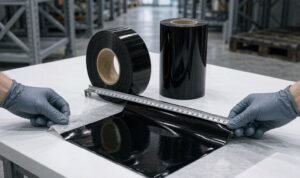
Step 2: measure a sample coupon yourself. Take five thickness readings per roll with a gauge, across and along the web. Reject anything under 180 microns on a 200-class film, or any spread wider than the stated tolerance — the same discipline that separates a durable film from one destined for early blistering, a failure mode we broke down in our piece on PPF hydrolysis in humid climates.
Step 3: run a window test you can afford. Even a modest accelerated exposure — a few hundred hours of UVA under ASTM G154 on a white test panel — will separate a stabilized aliphatic film from a fake by visible b-value drift. If you cannot run it locally, split a coupon and ask any third-party lab for a quoted 300-hour screen.
Step 4: stress the adhesive. Bond a coupon to a painted test panel, age it warm and humid for a week, then peel. Compare against the fresh bond. A film that loses most of its adhesion in seven days will not survive three years under a sun-baked rocker panel.
Step 5: place a pilot order, not a container. Ten to twenty rolls, invoiced with batch codes, installed on your own shop vehicles first. Track them for one quarter before you commit volume.
A real case, with numbers: a shop auditing two “equivalent” 200-micron films ran the five points above. Film A measured 197 to 208 microns across five rolls, haze 0.9 percent, and b-value drift of 1.4 after its 300-hour UVA screen. Film B measured 164 to 191 microns, haze 2.1 percent, and drifted 4.6 in the same window — and its reports carried a different product name than the quote. Film A cost 22 percent more per roll. Film B’s failure pattern, projected across a two-hundred-car year at the re-do labor rates this shop charges, would have erased the entire unit-price saving several times over. The audit cost the shop one week and a few square metres of film.
The bottom line
In a market where anyone can print “10-year warranty” on a carton, the only protection that works is the audit you run before the money moves. If a supplier resists the four questions in that table, they have answered them.