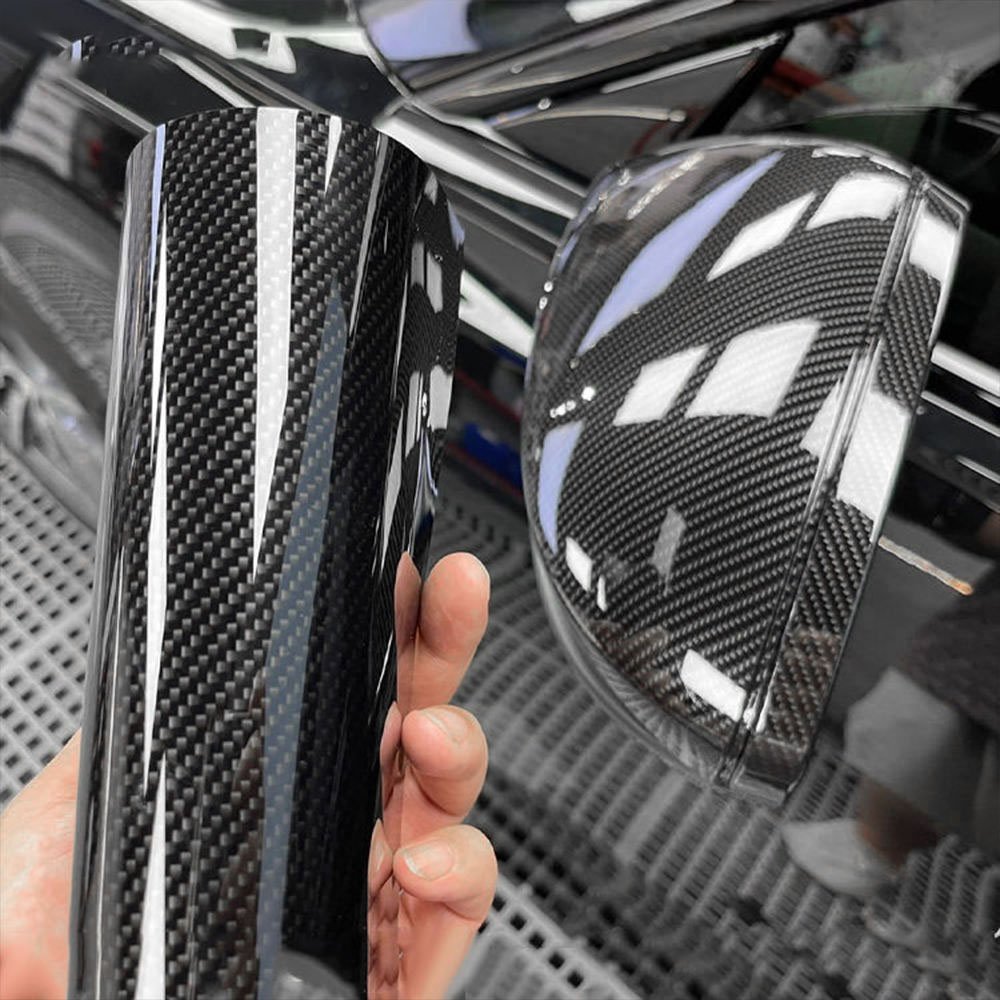
A shop quotes a stealth satin PPF install on a new Defender at $7,400. Three days later the customer forwards a $4,300 quote for a “matte wrap” from a shop two suburbs over and asks a fair question: why is yours 70% more for the same look?
The shop has two bad options. Discount to $5,200 and hand back most of the margin, or explain the difference badly and lose the job to someone who will happily install 4 mil matte PVC on a $90,000 vehicle. Both outcomes come from the same mistake — treating “matte finish” as a product category rather than a finish applied to two completely different substrates.
They are not the same product. They are not even the same polymer. And the gap stops being a price argument the moment you measure it.
Two products, one word
A matte cast vinyl wrap is a 3–4 mil (76–102 µm) PVC film with a textured or matte-finished face. A satin PPF is a 7.5–8 mil (190–203 µm) TPU film whose clear coat is engineered to scatter light instead of reflecting it. At three feet in a showroom, they can look close enough to fool the customer. At year three, in a car park under direct sun, they do not.
If your customer is already comparing finishes, our breakdown of high-gloss versus matte TPU PPF covers where satin sits between the two — useful before the conversation turns into a swatch argument. The four dimensions below are what you actually sell, and every one of them can be put on a spec sheet.
1. Finish consistency, measured in gloss units
“Matte” is not a binary. Measure it at 60° incidence and you get a number: matte cast vinyl typically reads 2–5 gloss units, satin PPF 8–15 GU, gloss PPF 85–95 GU.
Two rolls of matte vinyl from different production lots can differ by 3 GU. That variation does not show on a single door panel cut from one roll. It shows six months later when a repaired fender is wrapped from a new lot and sits next to the original doors under showroom lighting — one panel looks slightly flatter, and the customer sees it immediately.
Ask for a GU reading per roll, not “matte” on a swatch. A supplier who cannot produce the number has not measured it.
2. Thickness, and what actually hits the panel
This is the part customers discount and shouldn’t. A 3–4 mil vinyl is a color layer. An 8 mil TPU film is an impact layer, and the difference is not theoretical: on a gravel-loaded highway, a 4 mil vinyl transfers stone energy into the paint below, while a TPU film absorbs and disperses it.
The honest way to frame it in a quote: vinyl changes what the car looks like, PPF changes what happens to the car. If the customer’s route includes highway commuting or a gravel driveway, that second function is the purchase.
3. Self-healing only exists on one of them
A satin PPF top coat carries mobile chain segments that re-flow above roughly 40–60 °C, which is why light wash marring disappears after a hot day. Matte vinyl has no healing layer; a scratch is permanent.
But there is a trap on the PPF side too: a satin or matte top coat cannot be polished. Any shop that tries to remove a scuff with compound will burnish the texture into a permanent gloss patch. Heat is the only correction method, and it has a ceiling — deep scratches stay. Set that expectation at handover, in writing, or you will argue about it in month eight.
4. Aging, shrinkage, and the removal bill
Cast PVC relaxes over time and shrinks, typically 1–3% across five years. On a matte finish, shrinkage shows up as a thin gloss line at every edge where the adhesive is exposed — the single most common reason a “still fine” matte wrap gets replaced early. The same shrinkage makes removal slower: expect 8–14 hours on a five-year-old wrap versus 6–8 for TPU.
TPU does not shrink the same way and comes off in fewer, larger pieces with less adhesive transfer. On a vehicle with original paint underneath, that difference is worth real money at trade-in — the same reason TPU and vinyl wraps diverge on resale even when both look intact from ten feet.
| What to ask | Why it matters | Typical good value |
|---|---|---|
| Gloss units at 60° | Finish consistency across lots | Satin 8–15 GU, with per-roll reading |
| Base polymer | Impact absorption, shrinkage, removal | TPU (aliphatic), not PVC |
| Film thickness | Stone-chip energy management | 7.5–8 mil (190–203 µm) |
| Healing temperature | Whether marring recovers in real sun | Reflows 40–60 °C |
| Shrinkage after aging | Edge gloss lines, premature replacement | ≤1% over 5 years |
| Removal time / residue | Labor at end of life | 6–8 h, minimal adhesive transfer |
| Polishing allowed | Prevents burnished gloss patches | No — heat only |
Specifying a stealth job so it survives year three
Step 1 — Sample on the actual panel, in daylight. Not a swatch book under shop LEDs. Satin on a dark grey reads differently than satin on white, and the customer needs to approve the panel, not the chip.
Step 2 — Measure the sample. Put a gloss meter on it. Record the number on the job card. This is your defense in a “it looks different from the other side” conversation.
Step 3 — Confirm the top coat, not just the base. Ask whether the satin finish comes from a textured top coat on TPU or from a matte additive in the adhesive-side liner. Only the first heals and resists UV the same way.
Step 4 — Post-heat every edge. 90 °C at the edge with a controlled heat gun, then hold pressure until cool. Satin films hide lifting better than gloss, which is exactly why lifting gets missed and comes back a year later at the wheel arches.
Step 5 — Hand over a care sheet that says “no wax, no polish.” Matte-safe wash only, no automatic brush tunnels, no compound. A single well-meaning detailer with a rotary polisher can destroy a satin finish in one pass. Put the same note on the invoice, because the detailer is often the customer’s own guy, not yours.
One more thing worth saying out loud in the quote: satin PPF on a leased or financed vehicle is usually the cheapest way to keep the factory finish undamaged without changing the factory color. That is a different sale from “make it look stealth,” and it closes faster with fleet and leasing customers than any conversation about gloss units.
What the 70% actually bought
A dealer group ran the comparison properly on twelve Defenders over fourteen months — six on matte cast vinyl, six on satin TPU PPF, all daily-driven in the same climate.
At fourteen months, four of the six vinyl cars had edge lift at the wheel arch returns, and three showed burnished gloss patches where hand washing had been too aggressive. All six PPF cars were intact; one had a scuff on the rear quarter that healed after a hot afternoon.
The vinyl jobs cost roughly 60% less up front. Three of the six needed partial re-wraps inside the first two years — at which point the total spend had passed the PPF price, with the inconvenience on the customer’s side.
Bottom line
Stop quoting a finish and start quoting a system: polymer, thickness, gloss units, healing behavior, removal cost. When the customer sees four numbers instead of the word “matte,” the $7,400 quote stops sounding expensive and starts sounding specified.
And if they still choose vinyl, that is a legitimate decision — some customers want a look for three years and will change it anyway. Our colored PPF versus vinyl wrap comparison is a fair brief for that conversation. Just make sure the choice is informed, because the shop that wins on price is also the shop that gets the call in month fourteen.
For the film side of the decision — thickness ranges, top coat behavior, and what to verify before a roll goes on a car — start with our Película TPU PPF range and match the spec to the job.