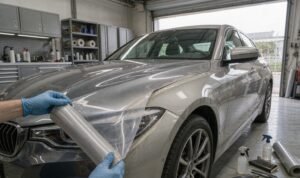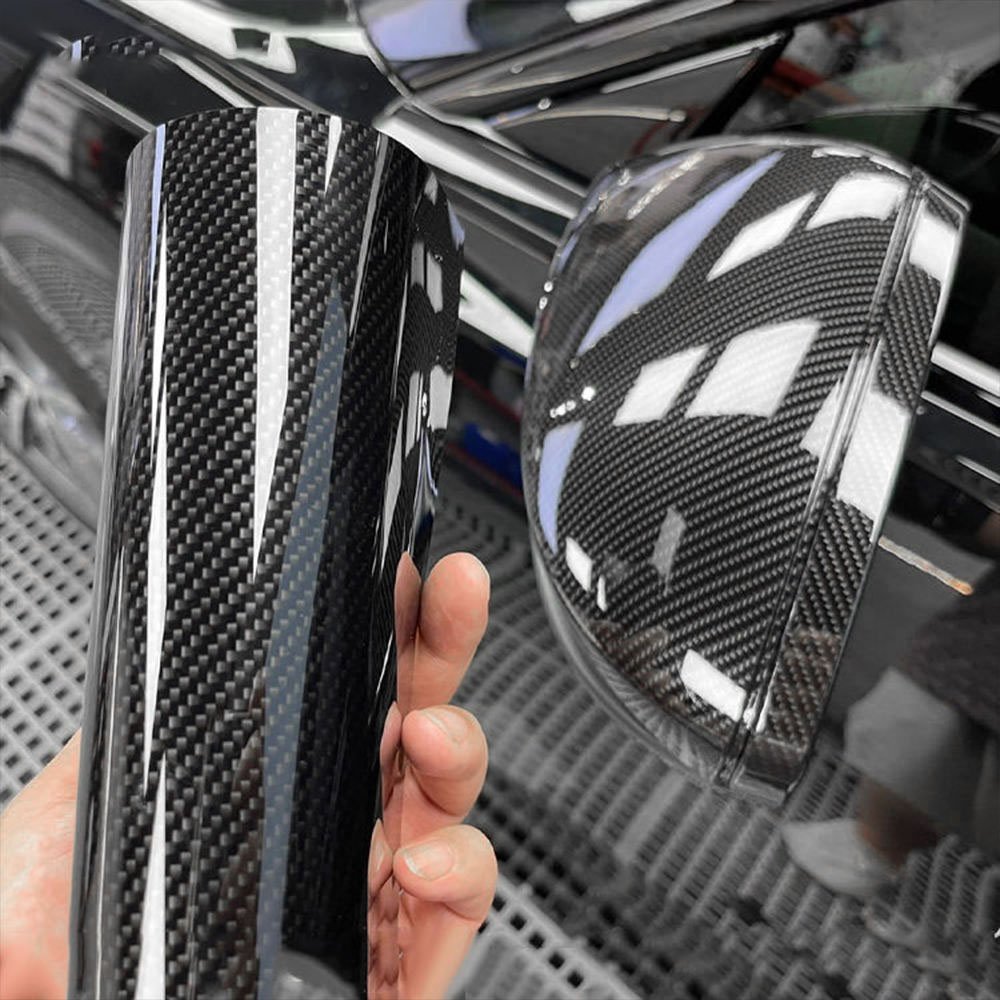
A shop wraps a full hood from a well-cut design file and the vinyl arrives from the plotter two millimetres oversize on every edge. The installer trims on the car to fix it, burning forty minutes, or leaves the gap as cut and the customer photographs the uneven margin next to the headlight. Nobody in the shop touched the file wrong. The error was baked in between the software, the printer, the laminator, and the plotter, and nobody had measured it.
Plotter accuracy is the most neglected number in the car wrap vinyl workflow. Shops calibrate nothing and discover the drift through rework. The good news is that the entire error chain can be quantified in about twenty minutes with a steel rule and a caliper, and once you know your machine’s numbers, most of the on-car trimming that eats your labor budget disappears. Here is where the error comes from, how big each source can get, and a calibration routine you can run before the next job.
Four Places the Error Hides
Scale mismatch between design and media. Design software assumes the printed media matches the cut file one to one. It rarely does. Laminated cast vinyl relaxes and shrinks after lamination, typically 0.5 to 1 millimetre per metre, and some media continues to move for hours. On a 1.5 metre wide hood panel, that is a 0.75 to 1.5 millimetre error before the blade even touches the film. Print-to-cut registration on printer-cutter combos adds its own offset, commonly 0.2 to 0.5 millimetre, which shifts every contour the same direction.
Blade offset error. Every plotter blade has a physical offset, the distance between the blade tip and the center of the swivel axis. Standard 45 degree blades run around 0.25 millimetre, deep-cut 60 degree blades closer to 0.5 millimetre. If the machine is set for the wrong blade, every corner gets rounded and every straight edge shifts by up to the offset error. On a panel with two dozen corners, the visual result reads as sloppy even when the total error is under a millimetre.
Feed skew and wander. Media loaded even slightly crooked, or fed over dirty grit rollers, tracks progressively off line. Over a 1.5 metre width and a 3 metre panel, skew of 1 to 3 millimetres is common in shops that never check. The cruel part is that skew is directional: the left edge of the panel can be perfect while the right edge carries the whole error.
Design gap versus working stretch. Most design files leave a 1.5 to 3 millimetre gap between film edge and body line. Cast vinyl takes a working stretch of 30 to 40 percent during install, and stretch consumes gap. A 2 millimetre gap on a 600 millimetre panel that elongates 5 percent during installation loses roughly 1.5 millimetres of margin across the panel, which is why on-car trimming rules exist in the first place. If the film was already cut oversize, the gap closes to nothing and the installer is trimming paint by feel. The design gap, the cut accuracy, and the stretch behavior have to be priced together.
| What to check | Why it matters | Passing range |
|---|---|---|
| 100 mm test square, cut only | isolates plotter mechanical accuracy from printing | ±0.3 mm on both axes |
| Print-to-cut registration offset | shifts every contour uniformly | ≤0.5 mm |
| Blade offset setting vs blade type | wrong offset rounds corners and shifts edges | offset matches blade spec (0.25 mm / 0.5 mm class) |
| Feed skew over full width | directional error, worst at one edge | ≤1 mm over 3 m of feed |
| Cut edge vs design gap after install | the number the customer actually sees | design gap 1.5–3 mm, installed variance ≤0.5 mm |
| Liner condition under cuts | through-cut liner tears during weeding and alignment | liner intact, blade tip not exposed |
The Twenty Minute Calibration Routine
Step 1. Cut a 100 by 100 millimetre square with a 50 millimetre circle inside, film only, no printing. Measure it with a caliper. Repeat in three positions across the plotter width. If any dimension is outside plus or minus 0.3 millimetre, correct scale in the machine or RIP before anything else.
Step 2. Verify the blade offset against the blade actually installed, and cut a star or corner target to confirm corners come out sharp. This takes two minutes and fixes the majority of visually sloppy edges.
Step 3. Run a full-width feed test: plot registration marks front and back across a 3 metre feed and measure skew. Clean the grit rollers, reload the media square, and re-test until skew stays under 1 millimetre.
Step 4. Cut one real panel file in cheap vinyl, apply it to the vehicle or a practice panel, and measure the gap at six points with a feeler gauge or steel rule. Compare against the design gap. The difference is your true system error, and it is usually 60 to 80 percent smaller than the on-car trimming you have been doing to compensate.
Step 5. Save a material profile per film family. Cast car wrap vinyl and Color TPU PPF are not interchangeable here: color PPF works at 15 to 25 percent stretch versus 30 to 40 for cast vinyl, so its design gap needs to be set wider and its plotter profile softer. Shops that run one profile for everything are quietly choosing which jobs come out wrong.
Re-run Steps 1 and 3 whenever you change blade type, film family, or laminate roll, and after any roller service. Drift is not a one-time event: blades wear, media formulations shift between production lots, and a new laminate can change shrinkage by a few tenths of a millimetre per metre. Shops that log the three-position measurements per change build a history that makes any future dispute with a media supplier short, because you can put measured numbers from two lots side by side on the table instead of describing a feeling.
One case from a two-installer shop makes the money visible. Before calibration, their average gap error measured 1.8 millimetres across panels, and on-car trimming averaged 45 minutes per full wrap. After the routine above, error dropped to 0.4 millimetres and trimming fell to under 10 minutes per wrap. At 20 wraps a month and a 75 dollar shop rate, that is roughly 875 dollars a month recovered, from a routine that consumed twenty minutes once and a scrap strip per film change.
What This Buys You on Real Jobs
Calibrated plotters change more than rework hours. Measured gaps let you quote factory-paint-safe installs with confidence, because you are no longer deciding edge quality with a blade near the customer’s clear coat. They make pre-cut files and bulk roll work interchangeable, since both land inside the same half-millimetre tolerance. And when a dealer or fleet client audits your process, a calibration log with dates and measured values is the kind of evidence almost no competitor can produce on the spot. The same discipline transfers directly to Color TPU PPF work, where the stiffer film punishes sloppy cutting harder than cast vinyl ever will.
The Bottom Line
Your plotter’s error is not a feeling, it is a set of four measurable numbers, and every one of them has a passing range you can check in twenty minutes. Shops that measure cut accuracy charge for installation instead of for trimming, and their edges prove it. Run the routine once this week; the rework hours you stop spending will pay for the caliper before the month ends.