The rear-end claim that came back short
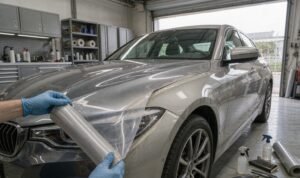
A shop in Texas installed a full body TPU PPF package on a customer’s SUV fourteen months ago. Invoice, 4,300 USD, registered warranty, photos of every panel. Last month someone rear-ended the SUV at a light, the insurer assessed the damage and the file came back with a settlement that covered the bumper and the quarter panel repainting — and said nothing about the film. The customer called asking why his 4,300 dollars of protection had vanished from the paperwork. The answer was ugly and simple: nobody had ever declared the film to the insurer, so from the carrier’s side it did not exist. The film is sitting on the car, undamaged, and still excluded from the conversation.
Nothing about that story is unusual. Insurers have been quietly tightening their treatment of paint protection film for a couple of years, and most shops still hand over the keys without a single sentence about insurance. The conversation happens at claim time instead, which is the worst possible place for it. This article is about closing that gap while the car is still in your bay — and the same checklist discipline works whether you sell car film for protection or for styling.
Insurers do not see protection. They see a modification.
The first quantifiable fact: from an underwriting standpoint, TPU PPF is a modification unless the film was applied at the factory during production, which is close to nonexistent. Global broker guidance including Lockton’s says this outright, and several carriers have used undeclared modifications as grounds to decline claims entirely or, more commonly, to exclude the film itself from coverage. Those are two different outcomes and shops should know both:
- Claim declined. The insurer treats the undisclosed modification as a breach of the duty to disclose material information. Rarer, but it happens, and it can put the whole claim — not just the film — into dispute.
- Film excluded. The claim proceeds, the car gets fixed, but the film is not replaced or compensated. This is the far more common outcome and it is exactly what happened in the Texas case above. The owner loses the film investment without any formal rejection.
The second number: what the film is actually worth on a settlement sheet. Retail installed pricing in most markets runs roughly 1,100 to 3,000 USD for full front coverage and 3,500 to 10,000 USD for full body, and labor is typically 35 to 55 percent of the ticket. Carriers rarely pay invoice price on accessories. The standard treatment is betterment or depreciation: for an accessory in the 24 to 36 month age range, expect a 30 to 60 percent haircut depending on the carrier and the policy. A 4,000 dollar full body film installed yesterday can settle near full value; the same film at two years old may settle at 1,800.
The third number: disclosure effort versus exposure. Declaring paint protection film to an insurer is a five to fifteen minute phone call or web form. The exposure you are protecting is a three-figure to four-figure asset. There is no other line item in your delivery process with that ratio.
What to ask, and what “good” looks like
| What to ask | Why it matters | Acceptable benchmark |
|---|---|---|
| Was the film declared to the insurer, in writing? | Verbal disclosure vanishes at claim time | Written confirmation (email or endorsement note) filed with the delivery pack |
| Does the policy list PPF as a covered accessory? | If it is excluded, the film pays for nothing after a crash | Endorsement or schedule naming paint protection film, not just “modifications” |
| What settlement basis applies? | Invoice value vs depreciated value decides the payout size | Full replacement under 12 months; expect 30-60% depreciation at 24-36 months |
| Can the shop produce the claim file on request? | The owner will call you first, not the insurer | Invoice, brand and lot number, install date, 8-12 dated photos, warranty registration |
That last row is where shops quietly win or lose. When a customer calls after an accident, the first question from the adjuster will be for documentation. If you can produce the invoice, the film specification, the lot number and dated photos of the installation within an hour, the claim moves. If you cannot, the film becomes an unproven aftermarket accessory and the exclusion does the rest. It is the same failure mode we covered in why TPU PPF warranty claims get rejected before anyone inspects the film — the chemistry almost never loses, the paperwork does.
The five steps that close the gap
Step 1 — Build the file at delivery, not at claim time. Invoice with film brand, product line, coverage area and price. Lot number from the roll. Install date. Eight to twelve photos under 1,000 to 1,500 lux angled lighting covering every filmed panel. Warranty registration confirmation number. Twelve minutes per car, nothing against the sixty to ninety dollars per hour your bay charges.
Step 2 — Make the disclosure script part of the handover. The customer needs to tell their insurer five things: that a professionally installed paint protection film was added, the brand and coverage area (full front or full body), the installed price, the install date, and that it was fitted by a shop. Give them the invoice copy to read from. Do not offer opinions about whether their carrier will cover it — that is the carrier’s call, and guessing wrong creates liability for you.
Step 3 — Get it in writing. Tell the customer to request written confirmation — an email from the insurer or a policy endorsement note — and to file it. Some insurers will simply note the modification and that is fine; the note itself defeats the “undeclared modification” argument later. A minority of carriers will refuse to list the film at all, which is a piece of information the customer is better off having before a crash, not after.
Step 4 — Diarize the renewal. Modifications get lost when policies are re-issued from scratch. At the twelve-month service wash or inspection, ask whether the film is still listed on the current policy. Thirty seconds per customer.
Step 5 — At claim time, act like a partner. If a filmed car comes in after a hail event, vandalism or a collision, photograph the film before anything gets touched, and remember that a repainted panel means the film gets cut away and sacrificed — a material repair cost, not a free byproduct. Provide the claim file within one business day. Shops that do this earn referrals from adjusters; shops that disappear get blamed for the exclusion they never mentioned.
The case in numbers. Two shops in the same metro, similar volume. Shop A added the disclosure script and the claim file to delivery in March. In October, a hail storm produced thirty-one film claims across its customer base: twenty-eight filed with documentation, twenty-six recovered partial or full film value — an average of 2,100 USD per car — because most films were inside the twelve-month full-replacement window. Shop B, same storm, same film brand, had no process. Nineteen affected customers, none declared, all excluded — roughly 41,000 USD of unrecovered film value, spread across customers who now associate the word PPF with a bad afternoon. Shop A spent about 370 dollars of labor building the files. That is the entire cost-benefit analysis.
The takeaway
Most PPF failures are argued about online; almost none of them are chemical. The film does its job, the paint underneath stays new, and the money leaks out through paperwork nobody wrote down. Declaring film to an insurer is not the customer’s problem and it is not the insurer’s problem — it is your process, because you are the one who will get the phone call. Put the script in the handover and the file in the drawer, and the worst insurance story your customer tells will be about the deductible.
If you are refreshing your own knowledge of what a professional installation should deliver before writing that script, compare notes against a current TPU PPF film specification sheet — the coverage areas and film specs you quote should match what you declare. And when customers ask which grade suits their budget, the honest answer about a clear TPU PPF option is usually the easiest one to insure, because the invoice reads like protection rather than a styling modification.