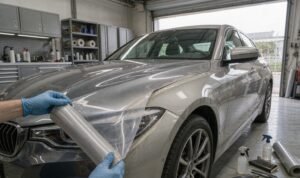
A 2019 sedan rolls into the bay with 61,000 km on it, freshly traded, detailed to a hard shine. The owner wants the full front covered before he starts commuting again. Under the shop lights the paint looks uniform. Under a gauge it does not: the hood reads 212 micrometres, the left fender 148, the doors 104 to 112. Two panels have been repainted, and nobody has said so.
Six months later, a shop two towns over films a similar car without checking. When that film comes off at trade-in, a palm-sized patch of clear coat comes with it. The customer blames the film. The film brand blames the prep. The shop pays for a respray and loses the referral.
That is the part of the job nobody puts in a quote. Film does not fail on repainted panels because the film is bad. It fails because the weakest layer in the stack is someone else’s paint, and the adhesive is stronger than the bond beneath it.
Four numbers that decide the job before you touch a roll
A pre-install paint audit is not a detailing inspection. It is a substrate check, and it takes about twelve minutes on a normal car. Four readings carry almost all of the decision.
1. Total film build and what is left of the clear coat
Factory paint on a modern passenger car usually lands between 100 and 180 micrometres total, with the clear coat alone at roughly 35 to 50. Outliers run from 75 on some roofs to 430 on SUV rockers. A single reading tells you almost nothing, which is why the gauge gets five points per panel and three readings per point, discarding any high or low that cannot be repeated.
What matters for film is not the total but the clear coat you are bonding to. Most manufacturers cap removal at around 8 micrometres of clear for polishing over the life of the car. A panel that has been compounded twice has very little of that budget left, and clear TPU PPF will bond to whatever remains, good or bad. Measure with a magnetic or eddy-current gauge to ISO 2178 and ISO 2360; plastic bumpers need an ultrasonic probe or a caliper on a cut edge, because a magnetic gauge will simply read the steel underneath and lie to you.
2. The panel-to-panel gap, not the absolute number
This is the reading most shops skip. A repainted fender at 148 micrometres sits comfortably inside the normal factory range, so nothing looks wrong until you compare it with the door next to it at 102. That 46-micrometre step is the signal. On modern cars, a difference of 40 micrometres or more between adjacent panels is a reasonable red flag for refinish work, while 35 micrometres of variation across a single factory panel is normal and means nothing.
The gap tells you three things at once: which panels were repaired, how much material went on, and whether the repair was a blend or a full panel. All three change your quote.
3. Interlayer adhesion, tested where nobody will see it
A cross-hatch test to ASTM D3359 on an inconspicuous spot (inside a door jamb, under the sill) takes two minutes and tells you whether the layers are actually bonded. A result of 4B or better is a green light. 3B is a conditional pass that belongs in writing, with the panel named. 2B or below means the paint is coming off with the film one day, and no warranty on earth covers that.
Refinish paint is softer than baked OEM paint for a structural reason: OEM clear cures around 140 to 150 degrees Celsius, while a body shop sprays and cures at 60 to 80. The film’s adhesive runs 600 to 1,200 newtons per metre by ASTM D3330, comfortably stronger than a marginal refinish bond.
4. Cure age and solvent history
Fresh solvent-borne clear needs about 30 to 60 days before film goes on; waterborne systems often need 60 to 90; an air-dried rural respray can take longer. Before that window, trapped solvent outgasses under the film and you get haziness, blisters, or a dull map of the repair six weeks later. Ask for the repair invoice and the spray date. If the customer cannot produce either, treat the panel as unknown rather than new.
| What to ask for | Why it matters | Acceptable range |
|---|---|---|
| Total dry film thickness, five points per panel | Flags respray and over-thick repairs | 100-180 µm total; anything above 250 µm needs a reason |
| Panel-to-panel difference | Detects undisclosed body work | Under 40 µm between adjacent panels |
| Remaining clear coat | Film bonds to clear, not to colour | 35-50 µm clear; assume 8 µm already spent if polished |
| Cross-hatch adhesion, ASTM D3359 | Predicts whether removal will pull paint | 4B or better; 3B only with written consent |
| Repair date and paint system | Solvent outgassing window | 30-60 days solvent, 60-90 waterborne |
| Written repair disclosure | Shifts removal liability off your invoice | Named panels, products, spray date |
The twelve-minute audit, step by step
Step 1. Map the car, not the panel. Six readings minimum per panel, one at each corner and two in the middle, recorded on a simple grid. Photograph the gauge display next to the panel so the numbers are tied to the car.
Step 2. Do the delta maths. Subtract each panel from its neighbour. Anything at or above 40 micrometres goes on the suspect list, and the suspect list goes into the quote as a line item, not a footnote.
Step 3. Tape the suspect panels. One cross-hatch, one pull. If the squares lift, the panel is not film-ready, regardless of how good it looks.
Step 4. Inspect edges and stone chips under raking light. Use 1,000 to 1,500 lux at 15 to 30 degrees. Lifting clear at a hood edge or a chip ring is a removal failure waiting for year five.
Step 5. Split the quote. Film the panels that pass. Decline the ones that do not, in writing, with the reading that justified it. Offer the customer a correction or a respray path instead of quietly covering a problem.
What that looks like on a real ticket
A 2018 sedan came in for full-front coverage, quoted at 1,850 USD. The gauge map read 212 on the hood, 148 on the left fender, 105 to 112 on the doors, 118 on the roof. The hood failed a 3B cross-hatch. The shop declined the hood and sold the fenders, mirrors, and bumper strips for 740 USD, with the hood documented as excluded and a note recommending a respray quote first.
Fourteen months later the same customer sent a photo of a car his colleague had done at another shop: full front, hood included, two lifted edges and a strip of clear coat the size of a credit card stuck to the back of the film. That removal cost roughly 480 USD in respray work plus six hours of labour, against the 1,100 USD the first shop had declined to take.
Where this leaves the quote
Film is a sealing layer. It seals whatever is underneath, including a repair that was never disclosed and a clear coat that is already tired. A gauge, a tape test, and a repair date turn that from a gamble into a decision you can defend a year later, when the customer is standing in your bay holding a peeled sheet of film and asking who pays.
The best film job is not the biggest one. It is the one where every panel under the film was measured before it was sold.
For shops standardising this audit across a team, the film spec matters as much as the substrate: start with a clear TPU PPF built on aliphatic resin and a documented adhesive, then let the gauge decide the coverage. If the car is coming back from a body shop rather than a used lot, the timing rules are different, and the 30 to 90 day window after a respray is the piece to read before you book it. Panels that pass today are also the ones most likely to survive removal at year seven, which is why the removal test most installers never run belongs in the same conversation. And when the audit clears a car, the film itself should be specified like a part number, not a colour: TPU PPF film bought on price alone is how a good substrate ends up under a bad sheet.