A box that says PCU and a datasheet that says nothing
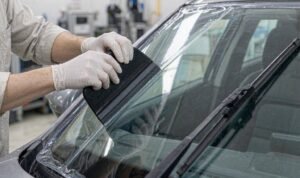
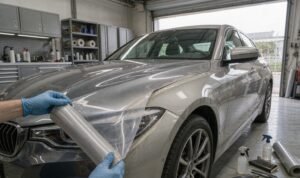
A shop owner outside Sharjah ordered a sample roll in September. The box said PCU, the label promised a fifteen-year warranty, and the quote was 38% above the clear film he had installed for four years. There was no resin name on the carton, no polyol on the sheet, and the technical data was a two-page brochure with a supercar photo and the word nano three times. He wrapped two hoods and one front bumper. The hoods were fine. The bumper bridged across the fog-light pocket, lifted at the return, and had to be reset twice before the car left.
The roll may have been perfectly good film. That is the uncomfortable part. PCU has become a label a converter can print on a carton without changing much inside it, and from the outside a buyer cannot separate a genuine polycarbonate-based roll from a repackaged standard one.
What PCU actually is
PCU is not a new polymer family. It is a thermoplastic polyurethane whose soft segment is a polycarbonate polyol instead of the polycaprolactone or polyether polyol used in most film. Every claim attached to it comes from that one substitution: better hydrolysis resistance, a higher thermal ceiling, better chemical resistance. So do the trade-offs: more stiffness at the same strain, lower elongation, weaker flexibility in cold weather.
1. Base-film identity: ask for the polyol, not the tier
There are roughly 50 to 70 film converters in China alone, buying base polymer from a far smaller group of resin producers. That gap is where the label gets loose: two rolls can both say PCU and come from different polyols and different casters.
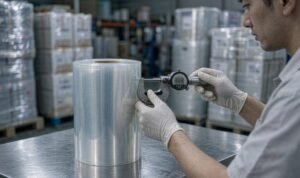
Ask for unglamorous things in writing: polyol family, diisocyanate type, base film thickness separately from total thickness, and a lot number that ties the roll label to an inspection record. Aliphatic HDI or H12MDI is the chemistry that stays clear. Aromatic MDI or TDI yellows under UV no matter how good the soft segment is.
2. Elongation decides which cars the roll can go on
This is the number that gets buried. Supplier data for PCU films tends to land around 150 to 250% elongation at break under ASTM D412, with one Gulf brand publishing 187% against 564% for its high-stretch TPU. Mainstream aliphatic TPU runs 350 to 450%, and 350% is often a contract floor.
Break elongation is not your working limit. Working stretch stays at 15 to 25% for clear film and around 15% for color, because that is where the topcoat and pigment layer survive. But at a fixed 20% strain a stiffer film carries more residual stress, and residual stress is what pulls film out of a recess eighteen months later. The failure mode is bridging, not tearing, which is why it passes inspection on install day.
The practical translation: PCU belongs on hoods, roofs, doors and fleet work, where the geometry is broad. It is a poor first choice for a bumper with deep pockets and compound curves. A Clear TPU PPF at 400% elongation remains the right default for complex fronts.
3. Two climates, not one
PCU is sold almost entirely on humidity, and the hydrolysis argument is real. Water attacks the polyol, chains shorten, the film hazes, embrittles and eventually blisters, a failure mode covered in more detail in this piece on PPF hydrolysis. A polycarbonate soft segment resists that far better than polyester and considerably better than polyether.
The comparable test is 240 to 500 hours at 85°C and 85% relative humidity, then haze under ASTM D1003, where a rise of 1 to 2 points is the usual pass line, and peel retention under ASTM D3330 after damp heat per ASTM D4585, where 70 to 80% of the original 600 to 1,200 N/m is the number to hold. Ask for hours, not adjectives: a film tested to 240 and one tested to 500 are sold with the same copy.
The neglected half is cold. A polycarbonate soft segment lifts the polymer ceiling to roughly 120°C against 90 to 100°C for a good polycaprolactone TPU, but it also raises the glass transition, which is why cold-weather brittleness and edge cracking appear in northern markets. One SKU cannot serve the Gulf and Scandinavia. Ask for a low-temperature result under ASTM D746.
4. Warranty length is a sales number
A fifteen-year warranty on a material in the market since roughly 2018 is a promise made at year seven of real service life, while a polycaprolactone TPU has more than a decade of field data behind it. Neither is dishonest, but they are different kinds of evidence.
Three questions settle it. Does the warranty cover film only or labor as well. Is it transferable. And who is the legal counterparty if the converter stops answering email in year four. Film-only coverage is worth roughly the price of the roll, while labor sits at 35 to 55% of the invoice and is where your real exposure lives. Most TPU PPF suppliers will answer the first question and go quiet on the third.
The audit sheet
| What to ask for | Why it matters | Passing range |
|---|---|---|
| Polyol family, diisocyanate type, resin source, lot traceability | The label travels faster than the chemistry; aromatic film yellows regardless of polyol | Aliphatic HDI or H12MDI, polyol named in writing, lot matched to an inspection record |
| Elongation at break, ASTM D412 | Decides which panels the roll can take without bridging | 150 to 250% means broad panels only; 350 to 450% covers complex fronts |
| Hydrolysis: 85/85 hours, D1003 haze rise, D3330 peel retention after D4585 | This is the entire reason to pay a premium | At least 240 hours, better at 500; haze rise 1 to 2 points; peel retention 70 to 80% |
| Thermal ceiling and cold limit, D746 or a bend test | One SKU sold into two climates is how failures start | 90 to 100°C continuous minimum; cold install floor known and stated |
| Warranty terms: years, labor, transfer, named entity | A long claim at year seven of field life is marketing until tested | Written exclusions, named legal entity, labor terms explicit |
Running it in one afternoon
Step 1. Order two production-matched samples, then cut six coupons at 100 by 100 mm from the middle of the roll, not the end, and label them with the lot number. Show samples are polished by definition.
Step 2. Stretch three to 15, 20 and 25% and hold for ten minutes. Measure haze before and after under ASTM D1003. A rise above one point at 20% means the topcoat is the weak layer, not the base film.
Step 3. Send the other three to a lab for 240 hours at 85/85. Check haze and peel afterward. This is the only test that separates a genuine polycarbonate roll from a relabeled one.
Step 4. Install one bumper and one hood from the same roll, and time both. If the bumper takes 40% longer and needs relief cuts on a shape your TPU handles in one piece, you have found the application limit.
Step 5. Write the result on the carton: polyol, hours, elongation, panel restrictions. Whoever pulls that roll next season will not read the brochure.
A distributor we work with took thirty rolls at 15.50 USD per square metre against 11.20 for its usual clear film and pushed them into a shop running 46 cars in eight months. Flat-panel work covered 35 of those cars with zero returns. The 11 cars with complex fronts produced five comebacks inside five months, each costing 3.4 hours and 2.1 square metres to redo, roughly 290 USD a car at 75 USD an hour. Call it 1,450 USD of rework against 46 cars of premium, so the premium still won on the spreadsheet. What did not show up there was one fleet account asking whether the film was defective.
What I would tell a buyer
Pay for the polymer when the climate justifies it, but pay for the paperwork first. A TPU PPF film roll that arrives with a named resin, a matched lot and a tested elongation number is worth more than a PCU roll that arrives with a story, because only one of them can be defended in year six when a customer walks in with a hazy hood. If your supplier cannot tell you what is inside the film, they are asking you to be the person who finds out.