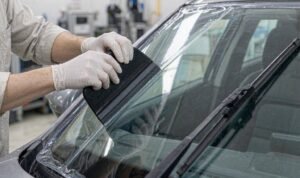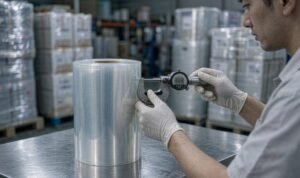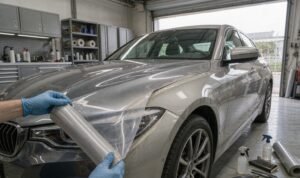
Every shop has one job it does not put on social media. Ours was a 2019 corporate fleet that came back last month: forty sedans wearing a full front of film bought on price six years ago. The re-fit quote was written in an afternoon. The removal stopped being a removal on the third panel, when the film started coming off in shreds and leaving a grey smear of adhesive across hoods that were otherwise perfect. Fourteen extra hours, one bay blocked for two days, and a customer who now believes all TPU PPF film behaves that way.
Nobody in that chain was dishonest. The film met every published spec when it was new: thickness, haze, initial peel. What nobody spec’d — what almost nobody specs — is what the adhesive does in year six or seven, when the car has spent its summers at 80 °C panel temperatures and the film has to come off.
Removability Is a Spec, Not a Personality Trait
The industry tests what is easy to test. Thickness with ASTM D374, haze with ASTM D1003, yellowing under ASTM G154, initial peel with ASTM D3330. Removability gets a marketing sentence: “clean removal, no residue.” That sentence is worthless to a distributor because it describes day zero, and the money is at day 2,500 — long after the container of clear TPU PPF has been sold and installed.
Here is the uncomfortable mechanism. A pressure-sensitive adhesive keeps cross-linking for years, especially with heat. Bond strength climbs. That is fine while the film stays on. The problem arrives when a customer books a re-fit or sells the car: the adhesive that held for seven years now holds harder, and if it has aged badly, it lets go of the film before it lets go of the paint. That is adhesive transfer, and it converts a half-day job into a two-day job with polish and solvent on every panel.
You can buy against this. The data exists, it is just not on the front page of the datasheet.
Four Numbers That Decide Whether Year Seven Is Cheap or Ugly
1. Heat-aged peel strength, and how far it grew. Datasheets already publish this if you look. XPEL lists Ultimate Plus adhesive at over 4 N/cm fresh, rising past 7 N/cm after 168 hours of heat ageing at 80 °C — roughly a 75 percent climb. 3M’s Scotchgard Pro Series 4.0 bulletin shows the same direction: adhesion up about 40 percent after 72 hours at 80 °C. Industry-normal fresh peel for a decent aliphatic film runs 600 to 1,200 N/m on D3330 or PSTC-101. The useful number is not the fresh value; it is the ratio. If a supplier’s own ageing data shows peel growth beyond roughly two times fresh, assume adhesive transfer in hot climates by year five or six.
2. Failure mode, measured as transfer area. Peel strength alone does not tell you who the adhesive betrays. Run a 25 mm strip off an aged coupon and look at it. Cohesive failure — glue staying on the paint in a continuous film — is the failure that costs hours. A practical acceptance line: residue covering under 10 percent of the strip area after heat ageing, with anything over 30 percent treated as a reject at container stage. This is a ten-minute test, and it separates films far better than any gloss number.
3. The removal temperature window. Cold film is how residue happens even on good stock. LLumar’s own guidance is blunt: remove PPF indoors at 55 °F or warmer, because in the cold the film can separate from its adhesive and leave the glue behind. Shop floor practice sits in the same band every time: warm the film surface to about 60 to 70 °C, fold the film back on itself at an angle of 45 degrees or less, and pull slowly and steadily rather than in yanks. A shop at 8 °C peeling dry film is manufacturing its own callback, whatever film it uses.
4. Substrate bond versus film bond. The last variable is not the film at all. Film adhesive in good condition bonds to sound factory clear at a level the paint can survive. On a repainted panel — especially one cured badly — the film can be stronger than the paint holding itself together, and a clean pull lifts the clear. ASTM D3359 cross-hatch at 4B or better is the usual floor before any film goes near a repaired panel. A shop that does not ask “has this hood been resprayed” before quoting removal has skipped the only question that can turn a 400-dollar job into a repaint claim.
| What to ask the supplier | Why it decides the bill | Acceptable range |
|---|---|---|
| Heat-aged peel data (168 h at 80 °C, 180° peel) | Predicts release behavior at end of service life, not day zero | Growth ≤ 1.5 to 2x fresh peel; no cohesive split |
| Adhesive transfer after aged peel | Residue hours are the hidden labor line on every re-fit | Under 10% of strip area; over 30% reject the lot |
| Minimum removal temperature | Cold pulls strip adhesive off the film and onto the paint | Film surface 60–70 °C; shop air 13 °C or warmer |
| Repaint policy and corner test | Repainted panels lift with the film during removal | D3359 ≥ 4B on repairs; 50 mm test patch before full pull |
How to Run the Coupon Test Before You Wire the Deposit
Step 1. Order a removal coupon, not another spec sheet. Ask the factory for a 300 mm length off the actual production lot, with the adhesive as shipped. If they cannot supply one, that itself is data.
Step 2. Age it honestly. Bake the coupon at 80 °C for 72 hours — a laboratory oven is enough for a screening test. For a container-level decision, insist on the supplier’s 168-hour aged data and match it against a coupon you age yourself.
Step 3. Peel it the way it will actually be peeled. Warm the coupon to 60 to 70 °C, fold the film back on itself at 45 degrees or less, and pull at a slow, constant rate around 30 to 50 mm per second. Record how the film releases: in sheets, in shreds, or with the adhesive staying behind.
Step 4. Grade the residue. Photograph the stripped coupon under raking light and estimate the transfer area as a percentage. Under 10 percent is commercial-grade. Over 30 percent is a lot you will be paying for in labor for the next seven years.
Step 5. Check the paint side. On any panel with bodywork history, run D3359 first, then a 50 mm corner lift before committing to a full pull. Write the repaint disclosure into your intake form; it is the cheapest insurance in this trade.
Step 6. Put removability in the purchase order. Aged peel growth ratio and transfer area percentage, with rejection rights at container inspection. Suppliers negotiate on price; nobody argues with a test they can replicate on a bench.
What the Numbers Look Like on Two Real Lots
A distributor we work with ran this protocol on two competing lots last spring, both nominally 190 µm transparent films. Lot A peeled fresh at 8 N/25 mm and grew 1.4 times after 72 hours at 80 °C; on the aged coupon it released in full sheets with barely a haze of residue. Lot B started at 9 N/25 mm — better on paper — and grew 3.1 times, shearing cohesively across roughly 55 percent of the strip.
The bill arrived eighteen months later on the first six re-fits. Lot A cars: 3.5 hours each for removal, 24 minutes of solvent wipe-down, zero paint issues. Lot B cars: over nine hours each, adhesive across most panels, and on two vehicles whose door panels had been resprayed before the film went on, the pull lifted clear coat — 400 dollars of repair before the new transparent TPU PPF could even be quoted. Total delta on six cars: about 2,300 dollars, on film that had saved the buyer roughly 7 dollars per car at purchase. The math does not need a spreadsheet.
The Verdict
A film that installs beautifully and removes like cement is not a bargain; it is a deferred invoice with your shop’s name on it. Test the coupon, not the brochure — and if a supplier will not put aged peel growth and transfer limits in writing, treat the whole catalog with suspicion, because a warranty that replaces film but not labor will not send anyone to help you scrape the year-seven mess off forty hoods.