The claim that died on paperwork
A shop in southern Florida filed a claim at month 26. White SUV, half hood and front bumper, both gone a visible cream against the doors. Photos attached, invoice attached, customer already booked for a re-do. Nine days later the answer came back: insufficient documentation. No roll or lot number. No baseline reading from install day. Photos shot at night under shop fluorescents, which push everything warm and make a yellowing argument impossible to win.
The film may well have been defective. Nobody could prove it, and a warranty department does not pay for what cannot be proven.
What actually happens in the first four minutes
Brands run claims through the same gate. A clerk checks identity first: is this our film, from a batch we shipped, installed by someone in our chain, inside the window. Only then does a technical reviewer look at the pictures and ask whether the condition is a manufacturing defect or wear.
That order matters. Step one is clerical, so it sits entirely within your control on install day, months before a claim exists. Brands do not pay out on how bad a film looks; they pay out on whether the file matches a claim they are permitted to approve.
Three questions decide almost every file. Is the film traceable to a specific roll. Is the complaint a measured change or an impression. Did the shop keep its hands off the material while the claim was open. Photographs alone rarely carry a claim, since a phone under mixed light turns a two-point shift into a five-point one. What they want is a number taken with the same instrument, at the same angle, as a number from day one.
Four things the file has to contain
1. Traceability down to the roll
The 3M warranty card asks for lot or run number, VIN, dealer ID and install date, and states the form must be complete for the warranty to be valid. Smaller brands ask for batch information “if available” and then treat its absence as grounds for inspection or decline.
Record the lot at receiving, not at install. Photograph the label on the roll before it goes on the rack, keep that photo in the job folder, and write the lot onto the invoice line. Thirty seconds of work, and it is the difference between reaching a reviewer and getting a form letter.
2. A baseline that turns yellow into a number
“Looks yellow” is an opinion. A shift of 3.4 points against a day-one reading of 0.7 is evidence.
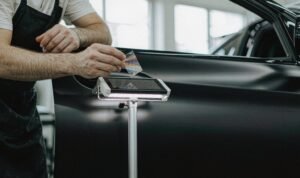
Take the baseline the day the film cures, with the meter you will use later, and write the serial number into the file, because a reviewer will ask which instrument produced the numbers. Three readings per panel group is enough: hood, one fender, one door. Record colour, haze and 60-degree gloss, since the three fail differently. A topcoat polished through shows a gloss drop with stable colour; resin breaking down moves colour first while gloss holds.
3. Photographs taken the way the next person will take them
The comparison photo is the one that matters, and it only works if both shots share geometry. Fix the routine: same panel, same distance, same light. Roughly 200 to 300 mm from the surface, a raking lamp at 15 to 30 degrees, and 1000 to 1500 lux on the panel, which is an inspection light rather than an overhead tube. Put a 10 mm marker or a coin in frame as a scale reference.
Eight to twelve frames per panel, plus a slow 15-second pan of the whole panel. Reviewers reject tight crops because a crop cannot show whether the discolouration follows the film or the panel gap.
4. Proof of care, and proof you stopped touching it
Nearly every claim form asks for maintenance confirmation, and several state plainly that film must not be removed or reinstalled before written authorization, on pain of losing reimbursement. That is not a formality. Once the film is off, the evidence is gone and the sample is gone with it.
Keep the care card the customer signed and the wash dates. If a defect appears, shoot before you touch, cut a 100 by 100 mm sample from the affected area when the brand asks, and store it flat in a bag labelled with the job number.
| What to ask | Why it matters | Acceptable range |
|---|---|---|
| Roll and lot ID on the invoice | First filter: our production batch, or someone else’s film in our box | Logged at receiving, label photo on file within 24 hours |
| Day-one colour reading | Turns “looks yellow” into a change a reviewer can accept | New film typically 0.5 to 2.0; a shift of 3 or more supports a claim |
| Haze at install, ASTM D1003 | Separates topcoat wear from resin breakdown | 0.6 to 1.5 percent new; a rise of 2 points is a finding |
| 60-degree gloss, ASTM D523 | Catches polishing damage the camera hides | 88 to 95 GU new; a drop beyond 5 GU needs explaining |
| Photo set per panel | The reviewer will never stand in front of the car | 8 to 12 frames, 1000 to 1500 lux, raking 15 to 30 degrees, 200 to 300 mm |
| Cure and aftercare log | Most denials cite maintenance, not film | 24 to 48 hours before wash, pH 5 to 9 soaps, no solvent or polish |
| Written hold on removal | Stripping before authorization usually voids reimbursement | Film intact, sample retained, claim filed within 30 days of first sighting |
The install-day routine that builds the folder
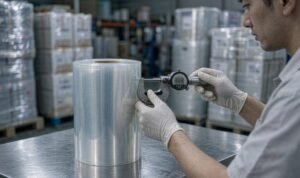
Step 1. At receiving, photograph the roll label and log lot, width and length against the delivery note. This is also where you catch a roll that arrived already aged, before it becomes a claim.
Step 2. Before wash, shoot the bare panel with the scale marker and record paint thickness at five points. If the paint is aftermarket, note it, because clear TPU PPF over a re-spray behaves differently and the brand will ask.
Step 3. At completion, record the baseline with meter serial, ambient temperature and relative humidity. A reviewer who sees 22 degrees and 45 percent humidity knows the film went on inside spec.
Step 4. Run the photo set to the fixed geometry, so a shot from month 26 can sit beside a shot from day one without argument.
Step 5. Hand over the care card and get a signature. Two lines on paper: first wash after 48 to 72 hours, no brush tunnels, no solvent cleaners.
Step 6. If a defect appears, re-shoot at the identical geometry, pull the day-one numbers, cut the sample if requested, and file within 30 days of first sighting. Registering the warranty within 30 days of installation is a separate clock, and skipping it voids coverage on any TPU PPF regardless of what the file contains.
Two claims, one shop, ten months apart
A shop doing roughly 380 installs a year filed two claims in the same stretch. Both were on clear film, both around month 24 to 26, both on white paint where any shift shows.
The first had no lot number, no baseline and night-time photos. Declined in nine days. The shop re-did the hood and bumper at its own cost: about 3.2 square metres of car film and 8.5 hours of labour, roughly 640 dollars of direct cost.
The second came off a car installed after the shop changed its intake routine. Baseline 0.7, month-26 reading 3.8, same meter, same lamp, eleven frames plus a pan, lot from the roll label, invoice with the lot written on it. Approved in nine days for replacement film on the affected panels. Labour still was not covered, which is normal and worth telling customers up front, but the material came back and the shop kept roughly 310 dollars it would otherwise have eaten. Building the folder took twelve minutes at install.
Twelve minutes against six to ten hours of unpaid rework. That is the whole economics of the thing.
The position worth taking
A warranty is not a promise the film will not fail. It is a promise that a failure can be documented, and documentation is shop-side discipline that no supplier can do for you. Build the folder on every car, including the ones you are certain will never come back, because the claims that hurt are always on the cars you were sure about.