The claim is approved in eleven days. The labor bill lands the same week.
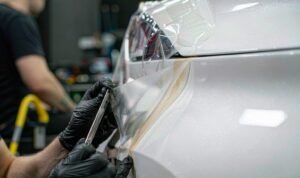
A shop in Queensland fits full-front TPU PPF film to a white Hilux in March 2023. Thirty-nine months later, six panels are drifting amber — past the point where an owner accepts “that is just UV”. The shop files a claim with photos, batch number and install record. The manufacturer approves it in eleven days and ships six panels free, exactly as the ten-year warranty promised.
Then the shop does the arithmetic nobody quoted for. Removing cured film from six panels: about 9 hours. Reinstalling: 13.5. Twenty-two and a half hours of bay time at AUD 95, on a car handed back in 2023, for a customer paying nothing because the warranty promised ten years. Call it AUD 2,100 — the gross margin on two and a half full-front jobs, spent honouring a promise someone else made.
That gap between warranty and remedy is the most mispriced line in the PPF chain, and it is locked in at purchase, not at claim time.
A warranty is four numbers, not one
“10 years” is a marketing ceiling. What you buy is four clauses that decide whether a failure costs film or a technician’s week.
1. Remedy scope: film only, or film plus labor
Most programmes remedy a valid claim with replacement material for the affected panels, and exclude removal labor, reinstallation, paint correction and downtime. A minority — usually the premium tier sold through certified installers — cover labor too, often capped per panel rather than as open hours.
Industry norm: labor runs 35–55% of a retail PPF ticket — USD 630–990 on a USD 1,800 full-front job, sitting in hours rather than material. A film-only warranty therefore covers a bit under half the real cost of a failure, and the failures you actually claim on are the labor-heavy ones.
Ask it in units you can price: labor covered or not, and what is the cap per panel? “Film + labor, capped at USD 45 per panel” is worth USD 45 a claim. “Material only” is worth the film and nothing else.
2. What “yellowing” means numerically
This is where most documents are deliberately vague. “Premature yellowing” is undefined in a large share of programmes, so the decision rests on someone’s opinion of a photo.
A film that can be measured publishes a threshold and the test behind it:
- Premium tier: ΔE ≤ 1.5 after 4,500 kJ xenon-arc exposure (SAE J2527) or 28,000 MJ/m² outdoor-accelerated (ASTM G90) — the numbers XPEL publishes for its flagship film.
- Mainstream tier: ΔE ≤ 3 after 1,500–2,000 hours QUV (ASTM G154), a looser but still checkable bar.
- Yellowness index shift per ASTM E313, and haze per ASTM D1003 — a good film holds Δhaze under about 1% after weathering.
ΔE 1.5 sits near the limit of what a trained eye catches on white paint; ΔE 3 is visible in daylight. Both are legitimate products. What is not legitimate is naming yellowing without naming a number — you lose that argument in year four, with a customer standing in your bay.
3. Conditions that void the claim without anyone lying to you
Exclusions are where a warranty quietly shrinks. Recurring items: film over repainted or previously corrected panels; unapproved ceramic coatings; brush washes; pressure washing closer than roughly 60 cm to an edge; untreated bird droppings or sap; removal by anyone but the original dealer.
Two administrative conditions bite harder than the technical ones:
- Registration window. Fourteen to thirty days from install is typical. Miss it and the claim is decided on goodwill.
- Annual inspection. Some premium programmes require a yearly inspection by a certified installer, with the inspection fee paid by the owner. No record, no coverage.
Neither is unreasonable. Both get skipped by shops that never put them on the handover sheet — and the shop ends up arguing, not the driver.
4. Who is actually on the hook in year eight
A ten-year term outlives most importers. If the seller has been restructured, rebranded or replaced by a new distributor, “10 years” describes a document, not a counterparty.
Read three things: named warrantor, governing law, venue. A term under one US state’s law, arbitrated in that state, is no practical remedy for a forty-panel claim in Vietnam or the UAE — filing costs more than the claim. If the warrantor is an importer, ask what happens to open claims when the distribution deal ends.
| What to ask | Why it matters | Acceptable range |
|---|---|---|
| Film only, or film + labor? Cap per panel? | Labor is 35–55% of the job; film-only leaves you holding it | Film + labor capped at USD 30–60/panel, or a stated credit per claim |
| ΔE threshold for yellowing, and which standard? | Without a number, “yellowing” is an opinion | ΔE ≤ 1.5 (SAE J2527 / ASTM G90) premium; ΔE ≤ 3 (ASTM G154) mainstream |
| Haze limit after weathering (ASTM D1003) | Haze, not colour, is what makes film look dirty | Δhaze ≤ 1% after 1,500 h |
| Registration window and annual inspection? | Cheapest legal reason to decline a valid defect | ≤30 days registration; inspection free or ≤USD 50, logged by installer |
| Does coverage transfer to the next owner? | Transferable coverage is a resale argument your dealer can sell | Transferable within original term, one transfer |
| Named warrantor, governing law, venue | Decides whether a claim is economic at year 8 | Warrantor is the manufacturer or a locally liable entity |
| Pro-rata or full replacement in later years? | A depreciating remedy is a discount, not a warranty | Full material replacement for the whole term |
How to price a warranty before you sign
Step 1 — Get the schedule, not the headline. Request the full warranty document for the specific SKU in your market. Three suppliers, three documents, side by side. If a supplier cannot produce it, the ten years do not exist.
Step 2 — Convert the labor clause into dollars per kit. Average full-front ticket × labor share ÷ panels covered. That is what the clause pays per claim.
Step 3 — Establish your own claim rate. Rolling twelve months: accepted claims ÷ installs. Established shops land between 0.8% and 3%; high-UV markets and respray-heavy fleets run 4–6%.
Step 4 — Compute the breakeven. A supplier charging USD 0.55/m² extra for labor coverage on a 5.5 m² kit is asking USD 3.03 per job. At a USD 45/panel cap and 5 panels per claim, the clause returns USD 225 — one claim per 74 installs — 1.35% — before it pays for itself.
extra = 0.55 * 5.5              # USD/m2 premium x kit area
covered = 45 * 5                # cap per panel x panels per claim
print(f"{extra / covered:.2%}")  # -> 1.35% breakeven claim rate
Below 1.35%, buy the cheaper film and self-insure the labor. Above it — or if you install on older, repainted or high-UV vehicles — the clause is underpriced and you should be buying it.
Step 5 — Mirror it in your own paperwork. Your workmanship warranty is a separate product: shorter and narrower — 12 months on edges and lifting, excluded on impact and wash damage, void once another shop touches the panel. Customers conflate the two; the paperwork must sort every issue into film defect, install defect or damage, and price each.
Step 6 — Keep claim-grade evidence from day one. Panel list, batch code, install date, ambient temperature and humidity, paint thickness on resprayed panels, signed check-in photos. A year-five claim is decided by what you can prove; the batch code on the invoice is the difference between a manufacturing claim and an argument.
The checklist
- Warranty document in hand for the exact SKU, before the first pallet ships.
- Labor clause expressed in dollars per panel, not “comprehensive coverage”.
- A ΔE number and a standard behind it, in writing.
- Registration inside the window; inspection booked on your calendar, not the customer’s memory.
- Breakeven claim rate calculated — the premium either beats it or it does not.
- Your own workmanship term written, and shorter than the film term.
Ten years on paper costs nothing. Ten years you can actually execute costs 1–2% of revenue — and a supplier who will not put a ΔE threshold next to the word “yellowing” is telling you which one they sell. The measurement side is in how to vet a TPU PPF film before it yellows and film clarity on white paint; the commercial side starts with finding a reliable TPU PPF supplier, and the rest of the TPU PPF-folie archive covers the specs behind these warranties.