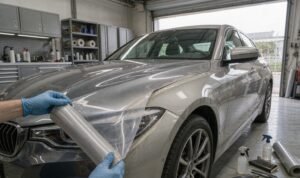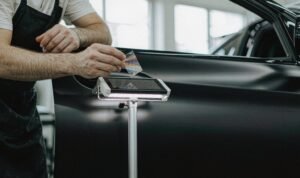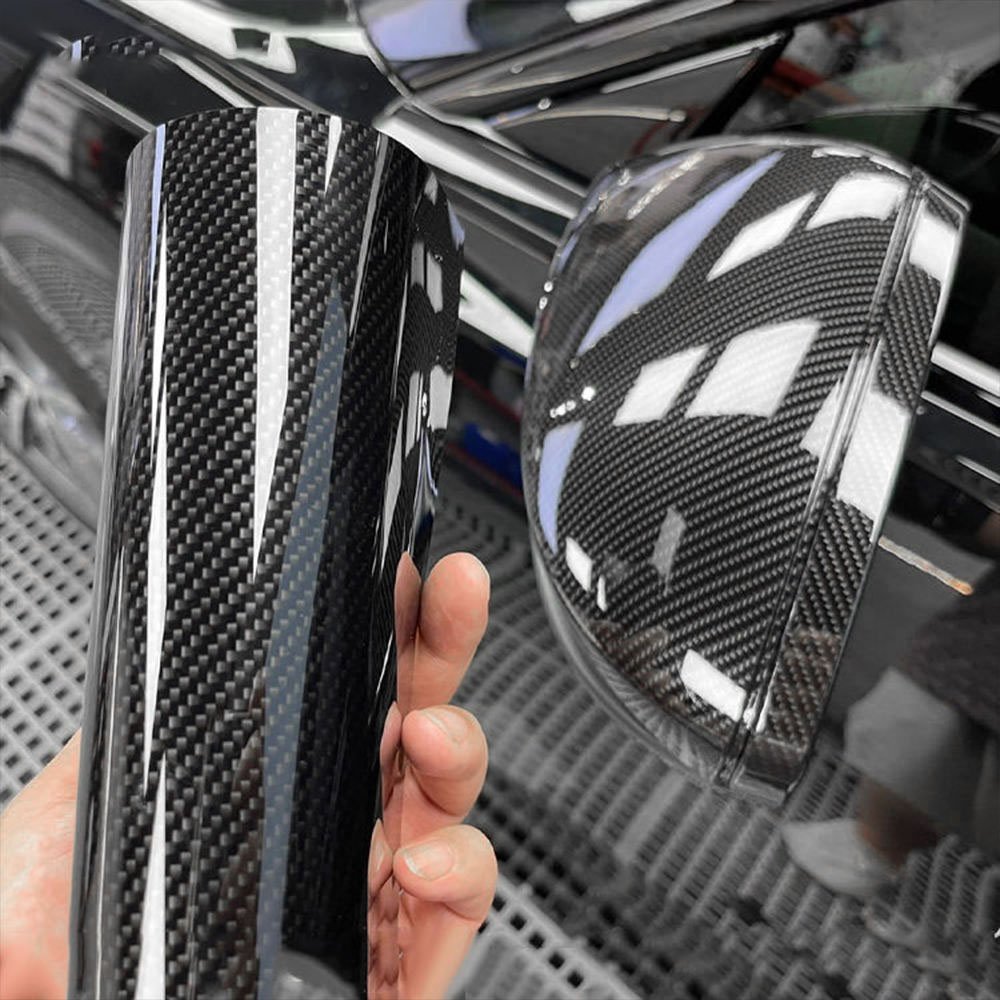
A dealer you supply calls on a Tuesday evening. His best customer just paid for a new windshield on a fourteen-month-old car — a crack from a truck’s tire tread, right in the wiper sweep. OEM glass ran $780, plus $240 to recalibrate the lane camera behind it. The dealer has seen windshield protection film promoted at two trade shows this year, including a visible push at Automechanika Dubai, and he is now holding quotes from $95 to $260 per roll meter with no idea what separates them.
He is not alone. Windshield film went from a curiosity to a real category in about eighteen months, and most of the people selling it are repeating marketing numbers they cannot verify. For a distributor deciding whether to stock it, that is an opportunity and a trap at once: the film is easy to demo and easy to get wrong.
What This Film Actually Is
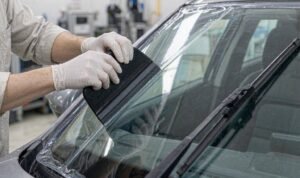
Windshield protection film is applied to the outside of the glass. That fact explains every specification that follows. Your interior car window tint exists to cut heat and UV from inside; this film sits in the weather, takes gravel hits, wiper abrasion and road salt, and its whole job is to sacrifice itself instead of the glass. The two are complements, not alternatives — a windshield tint inside plus protection outside is an easy upsell on any car with expensive glass, and the pairing slots naturally into any car film lineup.
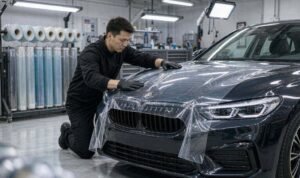
Construction splits into two camps. The first is a 4 to 4.5 mil optical PET film: cheap, optically excellent, but brittle, with a realistic service life of 1 to 2 years in sun-heavy or winter-salt climates. The second is a 6.5 to 7.5 mil TPU film — in effect a soft, optically tuned PPF for glass — with self-healing behavior against wiper marks and a realistic life of 4 to 7 years.
One thing this film is not: a heat product. TSER runs single digits to low teens — our earlier IRR versus TSER window tint breakdown covers why that number gets confused with broadband IRR. Judge windshield film on optics and impact, not cooling.
Five Numbers to Demand Before You Stock It
1. Haze and distortion, measured not claimed. On a windshield, optical quality is not a nicety; glare at night is a safety complaint waiting to happen. The number to ask for is haze per ASTM D1003: 0.5 percent or lower is premium, anything above 1 percent belongs on side glass, not in a driver’s sightline. Then run the low-tech test anyway: hold a sample at arm’s length against a distant straight line under a fluorescent tube — ripples mean a poor base film or lamination, and no datasheet rescues that. Compare within construction types, since PET is usually cleaner than TPU here.
2. Combined VLT, with margin. Windshield film must keep the glass-plus-film transmission legal: 70 percent or above is the common US standard and UNECE R43 benchmark for windshields. But film ages, and a film that measures 71 percent new can drift under 70 within two years of UV exposure. That is why serious suppliers target a film-only VLT of 88 percent or higher. Ask for the measured value, the instrument, and the standard — not the brochure number.
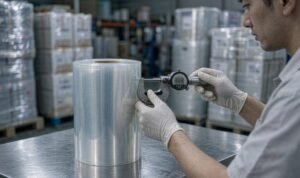
3. Base film and thickness, honestly labeled. A 4 mil PET film and a 7.5 mil TPU film both say “windshield protection film” on the box, yet they are different products with different lifespans. Require the label to state base material (optical PET or aliphatic TPU), total thickness in microns, and lot code. A blank label means no traceable origin and no claim on anyone when the film fails at month eight.
4. The yellowing clock, on a real test. Exterior film takes full sun. Ask how the supplier substantiates weathering: a UV chamber result such as ΔE ≤ 2 after 1,000 hours (ASTM G154 lamps) or 3,000 hours is meaningful; a “5 to 10 year warranty” with no test method behind it is not. Note what the warranty covers, too: one major supplier writes 18 months on a 4 mil PET product while advertising long base-film life in the same datasheet. In this young category, that gap between paper and marketing copy is yours to navigate.
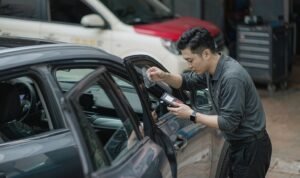
5. ADAS compatibility. Lane cameras, rain sensors and head-up displays all read through the top third of the windshield. The film must be non-metallized — any metallic or conductive layer can confuse camera exposure and distort HUD optics. That makes it both a pass/fail question and a selling point: a film that leaves ADAS untouched installs on every new car on a dealer’s lot without a calibration bill.
| What to ask | Why it matters | Acceptable range |
|---|---|---|
| Haze, with test method | Glare complaints kill the category | ≤0.5% premium, ≤1.0% ceiling (ASTM D1003) |
| Film-only VLT | Combined glass must stay ≥70% as it ages | ≥88% film-only |
| Base film and thickness | PET 1–2 yr vs TPU 4–7 yr service life | Labeled PET 4–4.5 mil or TPU 6.5–7.5 mil |
| Weathering data | Full-sun exposure drives yellowing | ΔE ≤2 @ 1,000–3,000 h UV (ASTM G154) |
| Metallization | Cameras and HUD read through the glass | Non-metallized, ADAS-safe by design |
How to Validate a Roll Before You Commit Money
Step 1: Demand the datasheet with methods attached. Haze, VLT, UV rejection (≥99 percent is standard, ISO 9050 or equivalent) and weathering, each with a named standard. “Laboratory conditions” with no method named is a sales sheet, not a datasheet.
Step 2: Test a coupon, not a photo. Cut a strip, apply it to a spare glass panel, squeegee it like a real install, then peel after 24 hours: it should come off clean, in one piece, no residue. Residue means a failed adhesive — that failure happens on your customer’s car, not yours.
Step 3: Run the wiper abrasion reality check. Wiper wear is the honest weak point of every exterior windshield film. Fit the filmed panel to a staff car for two weeks of real driving. Quality TPU with a hard top coat will show light tracking that self-heals with sun or warmth; PET that hazes in the wiper sweep will not survive the demo. Plan the maintenance story as well: wiper blades on filmed windshields should be replaced every 6 to 12 months, and a dry blade over a dirty film ruins any brand.
Step 4: Price the category the way the customer prices it. The comparison is never film versus nothing; it is film versus the next windshield bill. A windshield replacement on a modern car runs $400 to $1,500 or more, plus $150 to $600 for ADAS recalibration, plus a day without the car. A film refresh costs $150 to $400 installed and takes under an hour. Retail pricing in the 2026 US market runs roughly $450 to $750 on a sedan and $550 to $900 on an SUV, and a roll covers 10 to 13 windshields, so even a single-roll trial is a viable test.
Step 5: Decide which construction you stock first. A practical split: PET 4 mil as a low-cost, 1-to-2-year renewable product for fleets, leased cars and older vehicles; TPU 7.5 mil as the premium, longer-life product for new cars with expensive glass and ADAS. Trying to sell one film as both is how returns start.
A Fleet Example With Numbers
A leasing company with 12 highway-mileage sedans was averaging one windshield claim every three months — glass $600 to $900 each, recalibration $200, vehicle down a day. All 12 cars were filmed with a 7.5 mil TPU product at $180 per car installed, total $2,160. Over the following year the fleet logged 14 significant gravel hits on the windshield zone, all absorbed by film: zero glass claims, and one film replacement at $180 after a chip penetrated the film itself. The film did not make the windshields immortal — it moved the cost from an $800 glass event to a $180 consumable, and the fleet manager could see exactly what he was buying.
The Line Worth Saying Out Loud
Windshield film is not tint for the outside and it is not magic; it is a sacrificial layer with a measurable lifespan, and the only suppliers worth stocking are the ones who volunteer the haze number, the base material and the test method before you ask. Sell the clock, not the miracle — customers who know the film is renewable trust the product far more than ones who were told it lasts forever.