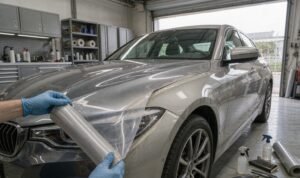
A customer walks in, points at a shade card and asks for “35” because that is the legal limit where you operate. You fit a 35 percent film, invoice it as legal tint, and six weeks later the car fails inspection at 27 percent. The meter at the inspection lane does not care what the box said. The customer wants the doors re-done for free, and the argument about whose number was right ends the same way every time: the box is not the window.
This is not an edge case. It is the single most common re-do in the car window tint business, and it survives because almost nobody quotes the two numbers that actually decide the result — the transmission of the glass underneath and the arithmetic that combines it with the film. Shops that meter the glass before quoting essentially never fail an inspection. Shops that sell label numbers fail them weekly and blame the meter.
Four Numbers Decide Whether Car Window Tint Passes
1. VLT multiplies, it never adds
A film’s label number is the visible light transmission of the film alone, measured on a bare sample in a lab. Once it is laminated to glass, light passes through both layers, so the window’s transmission is glass VLT times film VLT. Clear automotive glass is not perfectly clear: most new side windows measure between 70 and 82 percent, and laminated glass often sits lower. Run the math on one popular shade and the spread is dramatic: a 35 percent film on 88 percent glass reads 30.8 percent, on 80 percent glass it reads 28 percent, and on 70 percent glass it reads 24.5 percent. Same roll, same installer, three different windows. On a factory privacy glass measuring 20 to 30 percent, adding any film drops the window into the teens — which is why matching the appearance of rear privacy glass on the front doors is the classic trap in every showroom conversation.
| What to ask | Why it matters | Pass range |
|---|---|---|
| Baseline glass VLT per pane | The film multiplies against this number, not against 100% | Clear glass 70 to 82%; privacy glass 20 to 30% |
| Net VLT vs local limit | The meter reads the stack, not the label | At least 5 points above the legal minimum |
| Meter tolerance | The margin between pass and borderline citation | About plus or minus 2 points; average 3 readings |
| Measurement timing | Moisture and uncured adhesive skew early readings | 24 to 48 hours after install |
| Windshield rule | Separate rule from side glass | Film above the AS-1 line only; FMVSS 205 baseline 70% |
| Reflectivity and color | Separate limits that kill reflective and colored films | Reflective banned in most markets; verify local code |
2. The meter, and how it is read
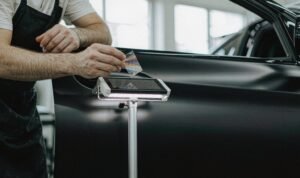
Handheld transmission meters carry an accuracy of roughly plus or minus 2 points. Temperature, dirt on the glass, sensor alignment and where on the pane you clamp all move the reading, so a window at 33 against a 35 limit could be anywhere between 31 and 35 in reality. Two-piece clamp meters that shoot through the glass are the more accurate class and the type most inspectors and shops use; single-sided units are faster but read slightly wider. Measure three spots per pane and average them, and do it after the film has dried out — 24 to 48 hours — because a wet adhesive layer still reads darker than the cured film. That tolerance band is the entire reason the margin policy below exists.
3. The per-pane rules you are actually selling against
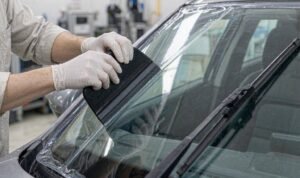
Front side windows are regulated hardest because that is where inspection attention sits. In the United States, roughly a third of states set 35 percent for front sides, the full range runs from about 20 to 50 percent, and a handful effectively require near-factory clarity. Rear windows are more relaxed in most codes. Windshields are their own regime: the AS-1 etched line, typically about five inches from the top, is the only strip that accepts film in most states, and the federal baseline for a windshield is 70 percent transmission under FMVSS 205 — which is also why a clear windshield tint strip sold for heat rejection has to clear the same 70 percent line, not just look invisible. Gulf markets run on a different map entirely — the UAE raised its floor to 50 percent VLT for side and rear glass, applies no allowance to the windscreen, and bans reflective film outright. Codes move, so the working rule is to verify the local regulation before quoting, not to memorize a chart from another market.
4. The margin policy
Given a meter that is honest within 2 points, a window that reads exactly at the limit is a coin flip at the inspection lane. The shops with clean compliance records choose shades that land the net VLT at least 5 points above the minimum. That single policy converts “35 percent film” from a product choice into an arithmetic outcome: on 75 percent glass in a 35 percent state, the film needs a label of 55 percent or lighter, because 0.75 times 0.55 lands at 41 while 0.75 times 0.50 lands at 37.5 — barely above the line and inside the meter’s noise. This is the arithmetic side of selling any car film, and it is the part of the quote most shops leave blank.
How to Install Compliance, Step by Step
Step 1: Meter every pane before quoting. Baseline the glass per window, not per vehicle. One SUV can carry 78 percent glass on the doors and 70 percent on the quarters.
Step 2: Compute the net. Glass VLT times film VLT, then compare against the local limit plus a 5-point margin. If the number does not clear the margin, change the shade or decline the shade the customer asked for.
Step 3: Write both numbers on the work order. Baseline, film label, predicted net. This one line turns a future dispute into a documented decision the customer signed.
Step 4: Meter after cure and log it. Three readings per pane, averaged, photographed with the readout visible, 24 to 48 hours after install. Hand the customer the sheet with the invoice.
Step 5: Refuse the mismatch jobs. Rear privacy glass does not need film for appearance, and any film added to it is a compliance risk with no benefit. Sell heat rejection on clear glass instead — a high-TSER ceramic at a legal VLT beats a dark cosmetic layer every time, and if the customer pushes back, the two numbers behind every quote — transmission and total solar energy — are worth a separate read on IRR versus TSER before you promise cabin cooling.
The case. A dealer accessory program tinted 14 new SUVs in one week using a uniform recipe: 35 percent film on the front doors, 50 percent film on the rear privacy glass. Baseline glass was never measured. The doors came out at 27.3 percent net on 78 percent glass against a 35 percent limit, and the rears landed near 11 percent. Nine of the 14 vehicles failed state inspection within two months. The fix cost roughly 130 USD per car in removal and refit labor at 65 USD per hour, plus film for the re-tinted panes — about 2,300 USD written off against a job that invoiced 4,900. The shop’s competitor, which meters baseline glass and refuses privacy-glass add-ons, ran 60 vehicles through the same season with zero inspection failures and zero re-dos.
Sell the Reading, Not the Label
The label on the box and the meter on the glass will disagree on every job, and only one of them has legal authority. The shops that treat VLT as arithmetic — measure the glass, multiply, keep a 5-point margin, log the result — have turned the most common re-do in the business into a five-minute step. The shops that keep selling label numbers are subsidizing the inspection lane one free re-tint at a time.