The invoice said 90 dollars: strip old tint off a lease-return sedan, two hours, easy money. Eleven days later came a second invoice — 380 dollars for a defroster grid repair, a free re-tint to keep the fleet manager happy, and a driver whose rear window cleared everywhere except one wide frost band. The tech who caused it had three years’ experience and had never once tested a grid line with a meter. Nobody had told him the rear glass was the most expensive square foot in the building.
Every shop that removes car window tint eventually learns this the hard way, and the lesson applies to any car film, tint or PPF. Removal is priced as an afterthought, an add-on line under the install. But the rear defroster grid is printed directly onto the inside of the glass, exactly where the film and the scraper work happens, and a 2-millimeter mistake on one line turns a 90-dollar job into a 400-dollar claim. The shops that stay profitable at removal are not the ones with better blades. They are the ones that treat the grid as the job.
What Is Actually Living Under That Film
A rear defroster grid is not wiring in the usual sense. It is 8 to 16 horizontal lines of conductive ceramic, silver or brownish, each roughly 0.5 to 1.5 mm wide, screen-printed onto the glass and fired in place, with bus bars at the edges where the 12-volt feed connects. Switch on and current flows through every line at once; the lines warm just enough to clear fog and frost. The system draws 10 to 20 amps — which is why a healthy line reading a few ohms reads infinite the moment it is scratched through.
That last sentence is the economics of tint removal. A 2 mm break in one line stops the current, and the glass beyond it never clears. The customer does not see a scratch — they see a frost band the width of one printed line, every winter morning, forever. Unlike a scratch on paint you cannot polish it out; the fix is conductive paint for small breaks or a full glass replacement — 300 to 1,200 dollars on a modern rear screen with embedded antennas.
Film age is the multiplier on all of this. Adhesive cures and bakes into the glass for years, so the calendar decides how the film lets go. Under three years, most film releases in sheets with modest heat. Three to seven years takes steam and patience, and the job starts matching the install time. Past seven years, removal turns into archaeology: the film tears, the adhesive fights, and every extra minute of scraping is another minute a blade or scraper edge spends in the neighborhood of a printed line. Film quality matters as much as age — dyed film sold on impressive IRR versus TSER claims tends to bake and fail early. Shops that quote removal flat-rate without asking the film’s age are quoting a job they have not seen.
Four Numbers to Check Before Any Blade Touches Glass
1. Grid continuity, before and after. The cheapest habit in tint removal costs nothing but two minutes: with the defroster switched on, probe each line end to end with a multimeter. A healthy line reads low — a few ohms up to a few dozen depending on length. Any line reading open, or showing a big voltage step along its length, marks a break that existed before you arrived. Photograph the reading: the pre-test is what separates “the grid was already broken” from “your tech cut it.”
2. Film age and adhesive state. Ask the year, then plan the heat. Fresh film needs 60 to 80 °C at the glass and peels in long pulls. Baked film needs steam, section by section, and the classic sun-and-plastic-bag slip-sheet method that releases adhesive in bulk instead of flakes. If the film is past seven years old or visibly failing, the job is no longer a 90-dollar add-on, and pricing it as one is how shops end up working at 20 dollars an hour effective.
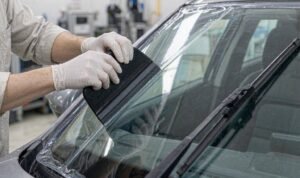
3. Release method: heat and angle, never dry force. The physics are consistent across every film: warm the adhesive to its softening band, fold the film back on itself at an angle of 45 degrees or less, and pull slowly and steadily. Speed is the enemy: a fast yank concentrates force exactly where a grid line sits. Scrapers, where they are unavoidable for residue, are plastic, used wet, at a shallow angle, and never dragged lengthwise across a printed line. A metal blade dry on frit or on a conductive line is not technique; it is a repair order you have not written yet.
4. The dot matrix and the edges. Modern rear screens carry a ceramic frit band and dot-matrix border where the bus bars live, and adhesive grabs that border hardest of all. Most removal damage happens in the last 20 millimeters, where somebody got impatient with residue. Accept that a faint adhesive haze at the frit is removable with chemicals; a broken bus bar tab is not.
| What to check or ask | Why it decides the outcome | Working standard |
|---|---|---|
| Grid continuity pre-test, per line | Establishes pre-existing damage and protects the shop | Every line continuous; a few ohms to a few dozen, photo logged |
| Film age and adhesive condition | Calendar decides heat, time and price | Under 3 yrs: sheet peel; 3–7 yrs: steam; 7+ yrs: quote by the hour |
| Removal temperature and peel angle | Force concentrates where the grid lives | Glass warmed 60–80 °C; film folded back ≤ 45°; slow, steady pull |
| Edge and frit discipline | Most cuts happen in the last 20 mm near the bus bars | Plastic scraper wet, shallow angle; no metal on lines or frit |
The Removal Protocol, Step by Step
Step 1. Interview the glass. Film age, brand if known, any previous removal attempts — a prior bad removal may already have scored lines under the residue.
Step 2. Test and photograph the grid. Defroster on, meter on every line, shots of the readings. Two minutes now, leverage later.
Step 3. Heat the film, not the glass’s temper. Steam or a heat gun at a working distance, glass surface in the 60 to 80 °C band. If the glass is too hot to hold a palm near, back off.
Step 4. Peel in sheets, low and slow. Start at an edge away from the grid bus bars, fold back on itself under 45 degrees, pull at a steady walking pace. Stop and reheat rather than force.
Step 5. Residue with chemicals, not steel. Citrus or ammonia-free adhesive remover on a soaked towel, dwell time, then a wet plastic scraper at a shallow angle. Lengthwise strokes across printed lines are banned, full stop.
Step 6. Retest, clean, and put it in writing. Meter every line again, photograph, clean the glass, and log the result on the job card. If the film was aged, the customer signs a grid-risk acknowledgment before the work — not after.
What It Looks Like on the Clock
Two shops stripped twelve lease-return sedans in the same month, all with six-to-eight-year-old film. Shop A ran the protocol: pre-test, steam, low-angle pulls, chemical residue work. Average 1.2 hours per car at a blended 65 dollars an hour, zero grid claims, and the photos on file when one fleet manager asked. Shop B quoted the same flat 50 dollars a car and dry-peeled with scrapers. Three grids damaged across twelve cars: two line breaks at 180 dollars each in conductive-paint repairs they paid for, one bus-bar tear that cost 340 dollars out of pocket, plus two free re-tints to settle the complaints. Shop B cleared about 260 dollars of margin on the batch. Shop A cleared 460 — and kept the account.
The Verdict
Tint removal is not a service; it is a liability transfer, and the defroster grid is what you are really being paid to protect. Shops that meter first, heat properly and refuse to dry-scrape a printed line do not just avoid the 400-dollar repair — they win the re-tint business, because windshield tint and rear glass customers come back to whoever did not break their car. Charge for the age of the film, document the grid, and let the competitor down the street be the cheap one whose customers learn what a dead frost band looks like.