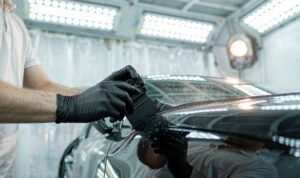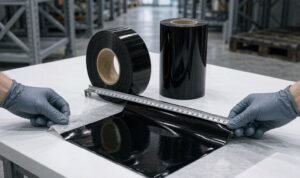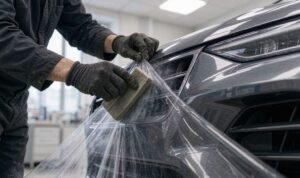
The quote was clean, the installation was clean, and the customer drove away happy in March. Eighteen months later he is back with a sedan that looks like it is sweating: a milky cloud across the bonnet, small blisters along every edge, two door corners lifted enough to catch a fingernail. The installer never touched the car again. Nobody cut a corner during installation. The film is dying from the inside out, and the failure mode has a name most buyers never hear: hydrolysis.
If you buy or install PPF in a humid climate — coastal cities, monsoon regions, anywhere cars sit overnight in a damp underground garage — hydrolysis, not yellowing, is what will actually end the film’s life. Warranty conversations default to yellowing and scratches, so the one chemical process that retires premium film early stays off the table. Here is how to put it back on the table, with numbers you can demand before you commit a customer’s car or your shop’s reputation.
What hydrolysis actually is, in terms you can measure
Conventional TPU is a block polymer: hard segments give it toughness, soft segments give it flexibility. Those soft segments are typically polyester or polyether chains, and their weak point is the bond that water molecules can attack. Under sustained heat plus humidity — think 35°C at 80 percent relative humidity, or a sealed underground garage in a coastal city — water slowly cuts those polymer chains. The film does not fade first. It fogs, blisters, and lets go.
Industry suppliers rarely lead with this because it is the hardest property to fix, which is why it has become the new battleground. In October 2026, several manufacturers launched polycarbonate-backbone films (marketed as PCU), replacing the vulnerable soft-segment chemistry with a carbonate structure that water attacks far more slowly. Whether or not you buy that specific material, the marketing push tells you where the real failure mode is. You need four measurable dimensions.
Dimension 1: Time in the hydrolysis danger zone. Film lives or dies on accumulated hours above roughly 30°C at high humidity. Labs accelerate this with the 85/85 test — 85°C at 85 percent relative humidity — where a few hundred hours stands in for years of tropical exposure. Film rated 8 to 10 years in a temperate climate can drop to 3 to 6 years in a hot-humid or coastal environment unless the chemistry resists hydrolysis. Ask suppliers to state, in years, the rated life for a coastal region, not just the headline warranty.
Dimension 2: Haze growth. Optical clarity is measured to ASTM D1003. A healthy aliphatic TPU film starts around 0.6 to 1.5 percent haze, and a reasonable end-of-life threshold for a premium product is a delta of no more than 1 to 2 points over the rated life. Hydrolysis blows through that: once water cleavage is advanced, surface haze can climb past 5 percent and the film reads as permanently cloudy even when polished.
Dimension 3: Adhesion retention. Peel adhesion to paint, measured per ASTM D3330 or D903 on standard test panels, typically sits in the 600 to 1,200 N/m range for a fresh film. Hydrolysis attacks the bond line itself, so the practical symptom is edge lift long before the rated date. If a supplier will share aged adhesion data — say after 240 to 500 hours of condensation exposure per ASTM D4585 — retention above 70 to 80 percent of the fresh value is the line you want to hear.
Dimension 4: Salt spray and chemical endurance. Coastal salt fog accelerates every moisture-driven failure. The standard reference is ASTM B117; credible hydrolysis-resistant films are typically validated at 500 to 1,000 hours without blistering. A supplier who quotes yellowing data (ASTM E313 delta YI) but cannot quote B117 or 85/85 hours has not tested the failure mode that matters in your climate.
The questions that separate hydrolysis-resistant film from marketing
Put these on one sheet and hand it to every distributor you evaluate. The pattern of what they will and will not answer tells you more than the brochure.
| What to ask | Why it matters | Acceptable range |
|---|---|---|
| Rated service life in a hot-humid / coastal climate, in years | Headline warranties assume temperate climates; hydrolysis halves life where humidity is high | 8-10 years temperate; 5+ years stated for humid-coastal use |
| Haze growth over rated life (ASTM D1003) | Hydrolysis shows up as haze before any other symptom | Start 0.6-1.5%; delta no more than 1-2 points over life |
| Aged peel adhesion after humidity exposure (ASTM D4585 / D3330) | Water attacks the bond line; edges lift when retention collapses | Retain 70-80%+ of fresh 600-1,200 N/m after 240-500 h |
| Salt spray endurance (ASTM B117) | Coastal chloride attack drives blistering from pinholes and edges | 500-1,000 h without blistering |
| Yellowing delta (ASTM E313) | Still worth asking, but it is the symptom everyone already checks | Delta YI within 1-2 points first year, per brand claims |
Only one of those five rows is about yellowing — that is deliberate, and it mirrors the shift running through the premium segment in 2026.
A five-step verification routine for your shop
Step 1: Segment your customers by moisture exposure before you quote. Three buckets: garage-kept temperate, daily-driver in a rainy or humid region, coastal within roughly 10 km of salt water. Quote different expectations for each, in writing. This alone prevents most of the “it went cloudy and nobody told me” conversations.
Step 2: Demand the humidity data sheet, not just the UV one. Any serious supplier of Clear TPU PPF can produce D1003 haze baselines and, increasingly, 85/85 or B117 hours. If a rep sends you gloss and yellowing charts only, treat hydrolysis resistance as unproven for that product and price your warranty accordingly — a reliable TPU PPF manufacturer will put climate-specific life ratings in writing without being pushed twice.
Step 3: Run a coupon test before you commit a full inventory order. Cut 100 by 100 mm coupons, apply to a test panel, and expose them where your climate actually lives: a sealed container with a damp sponge at 40 to 50°C for two weeks is a crude but honest tropical chamber. Inspect weekly for haze and edge lift. It costs you one afternoon and tells you more than a brochure.
Step 4: Set inspection gates at 6, 12, and 24 months. Photograph the same panels under the same light each time, watching haze at the edges first — hydrolysis enters through cut edges and pinholes. Catching a 0.5-point haze creep at month 12 gives you time to escalate with the distributor while the customer still has a perfect car.
Step 5: Write climate clauses into your own warranty. If you install in a coastal region, state the rated life and the inspection schedule in the paperwork. Shops that did this during the last wave of cheap TPH film imports kept their reputations; shops that promised a flat ten years everywhere are still absorbing reworks.
A real-world comparison makes the stakes concrete. A detailing shop in a subtropical coastal city installed two fleets with the same nominal 8.5-mil clear film in the same quarter — one from a conventional polyester-soft-segment TPU, one from a hydrolysis-resistant carbonate-backbone product. At the 24-month inspection, the conventional fleet showed an average haze delta of 2.8 points (D1003) with blistering at 11 of 40 door edges, and needed a partial refit costing roughly 40 percent of the original invoice in labor. The carbonate-backbone fleet measured a 0.9-point haze delta with zero edge lift. Same installer, same prep, same bay. The film chemistry was the only variable — and the refit labor cost more than the price difference between the two materials ever would.
Where this leaves buyers
Storage and handling matter too — a roll left half-open in a humid storeroom starts aging before it ever touches a car, which is why the roll receiving check on comliker.com matters as much as the spec sheet. But the bigger lever is what you demand from the film itself. For a related optical failure that installers cause rather than chemistry causes, see our piece on the stretch budget and how far TPU PPF can go before it hazes.
The 2026 shift toward polycarbonate-backbone film tells you everything: suppliers who actually engineer for humid climates now lead with hydrolysis data, and the ones who cannot produce a B117 hour count are betting you will not ask. Ask anyway — in a coastal or monsoon market, hydrolysis, not yellowing, is what your customers will see, and the shop that asks the right questions first keeps the account.