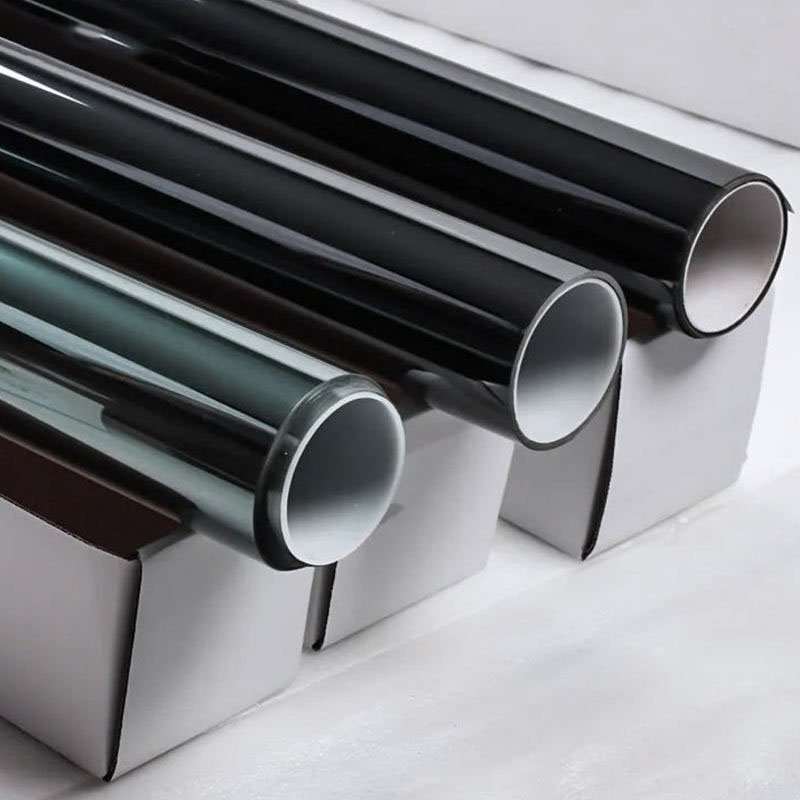

The mainstream materials for windshield tint film are multi-layer metal film and ceramic film:
Metal film: Magnetron sputtering technology, strong insulation (such as quantum diamond 70 insulation rate of 55%), but may slightly interfere with the signal
Ceramic film: Nano ceramic coating (such as dragon film crystal 80 with a thermal insulation rate of 47%), no signal shielding, suitable for new energy vehicles
Key parameters: Transmittance should be ≥ 70%, and UV blocking rate is recommended to be above 99%
PET substrate: Mainstream automotive ceramic films (such as Meiji V10 titanium nitride ceramic film) use polyethylene terephthalate (PET) as the substrate, and ceramic particles such as titanium nitride and zirconia are implanted into the substrate through magnetron sputtering or nanotechnology to form a multi-layer composite structure. This design combines high transparency (≥ 70%) and strong thermal insulation
Structural features: It usually includes a wear-resistant layer (4H hardness), a metal layer (vacuum aluminum plating), and an adhesive layer (pressure-sensitive adhesive). Some products adopt a “shallow front and deep back” gradient design

Hạt nền PET cao cấp và keo dán nhập khẩu từ các thương hiệu nổi tiếng.

Different Window tint are compatible with a 3-5 year warranty

Được chứng nhận bởi CE và ROHS, thân thiện với môi trường và an toàn.

Giao hàng nhanh chóng cho hàng hóa giao ngay, khoảng 7-15 ngày, hỗ trợ vận chuyển bằng đường biển và đường hàng không.
| Comparison Item | Metal Film | Ceramic Film |
| Heat Insulation | Reflective insulation, 61% IR reflectivity | Absorptive insulation, stable performance |
| Signal Interference | May block GPS/ETC signals | No metal layer, no signal interference |
| Durability | Prone to oxidation, 5-year warranty | Oxidation-resistant, 5–10-year warranty |
| Light Transmittance | Darker tint, may affect visibility | High transparency, clear vision |
| Price | Cost-effective | Technologically costly, relatively expensive |

| Sản phẩm | Car window tint film |
| Vật liệu | PET |
| Độ dày | 2 mil |
| Kích thước | 1.52*30 m |
| VLT | 15 |
| UVR | 99 |
| IRR | 92 |
| TSER | 89 |
Phim đổi màu xe ô tô là một loại vật liệu màng mỏng được áp dụng lên bề mặt xe, có khả năng thay đổi màu sắc của thân xe mà không làm hỏng lớp sơn gốc, đồng thời cung cấp một số chức năng bảo vệ. Tùy thuộc vào các loại vật liệu và chức năng khác nhau, phim đổi màu TPU sử dụng vật liệu cao cấp và kết hợp chức năng đổi màu cùng chức năng che phủ xe ô tô không nhìn thấy.


The mainstream materials for windshield film are multi-layer metal film and ceramic film, with the specific material composition as follows:
1. The multi-layer metal film adopts magnetron sputtering technology to uniformly sputter rare metals such as gold, silver, titanium, nickel, chromium, etc. onto the PET substrate.
2. In the field of automotive ceramic film, PET (polyethylene terephthalate) is commonly used as the substrate, such as the Meiji V10 titanium nitride ceramic film, which implants titanium nitride ceramic particles into the PET substrate.
1. Tránh rửa các cạnh bằng vòi nước áp lực cao: Không nên rửa xe trong vòng 10 ngày sau khi dán phim, và không nên rửa xe trong vòng 7 ngày.,
2. Vệ sinh kịp thời các vết bẩn cứng đầu: Các vết bẩn ăn mòn như vết dầu mỡ và kẹo cao su cần được làm sạch trong vòng 24 giờ,
3. Tránh môi trường cực đoan: Tiếp xúc lâu dài với ánh nắng mặt trời hoặc nhiệt độ không đều có thể làm tăng tốc quá trình lão hóa.
1. Giá của màng bọc xe TPU trong suốt, tiết kiệm chi phí và kinh tế dao động từ $250 đến $400 mỗi cuộn.
2. Sử dụng vật liệu nền TPU aliphatic nhập khẩu, được thiết kế đặc biệt cho các mẫu xe sang có giá trên 300.000 nhân dân tệ, có khả năng bảo vệ mạnh mẽ và bảo hành 10 năm. Chi phí phim dán xe khoảng $500 mỗi cuộn.
3. Vật liệu composite TPU nhiều lớp, phù hợp cho các dòng xe sang trọng cao cấp hoặc xe có yêu cầu quy trình đặc biệt, với giá khoảng $1000 mỗi cuộn.