The removal quote nobody budgeted for
A customer rolls in with a 2019 sedan wrapped in gunmetal gray three owners ago. He wants the original color back before selling. The last shop told him “wraps just peel off” and quoted one flat rate. Four hours in, his new installer is crawling along a rocker panel with a steamer, lifting postage-stamp fragments of sun-baked calendered vinyl, and the fender that was resprayed in 2021 has just handed its clearcoat to the film. The removal that was quoted at 400 dollars is now a two-day job and a paint correction conversation.
Every wrap shop has lived some version of this. The industry sells “fully removable” as a product feature, then quietly avoids the details that decide whether removal is a clean afternoon or a respray claim. Those details are numbers, and they are knowable before a single corner gets lifted.
Four numbers predict whether the paint survives
1. Film age against adhesive life
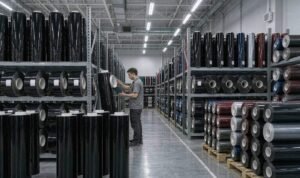
Cast wrap vinyl carries an outdoor service life of roughly 5 to 7 years, and the adhesive ages on the same clock. Under about 3 years, a cast film on healthy paint releases in large sheets. Between 4 and 6 years, plasticizers migrate out, the film stiffens, and the adhesive begins to cross-link under UV and heat cycling. Past 7 years, expect fragments, adhesive haze, and 2 to 3 times the labor. This is also why film storage life matters before installation: a roll that sat three years in a hot warehouse brings an already-tired adhesive to the car, which is a problem worth auditing at purchase time.
2. Surface temperature and peel angle
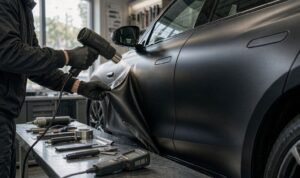
The working window is 45 to 60 degrees Celsius, measured at the peel line with an infrared thermometer. Below 45, the adhesive stays high-tack and the film snaps. Above 60, you soften clearcoat and adhesive together, which is exactly when paint starts coming up. Pull the film back on itself at 15 to 45 degrees, slowly. A vertical 90-degree pull concentrates force on the paint and transfers adhesive; a low-angle pull keeps the glue on the film. Heat must stay ahead of the peel line, one panel at a time, gun kept moving.
3. Substrate history: OEM versus repaint
Factory paint is baked at high temperature and bonds to the panel far stronger than any wrap adhesive. Aftermarket repaint is the coin flip. A respray that had less than 30 days cure before the film went on can lift with the vinyl, and single-stage or budget shop paint carries elevated risk at any age. No data sheet will save you here; only a test pull will. A 10 by 10 centimeter patch behind the license plate or inside a door jamb, heated and peeled, tells you in five minutes what the next six hours will do.
4. Residue as a measurable standard
Some adhesive transfer is normal and acceptable. A practical acceptance bar: residue on under 5 percent of panel area, removable with a clearcoat-safe adhesive remover at label-specified dwell time, no metal blades, no abrasive pads. Ghosting, the faint silhouette that stays after aggressive cross-linking, appears when a wrap has baked well past its service life, and at that point the job is priced as paint restoration, not removal.
The pre-job checklist
| Ask or measure this | Why it matters | Acceptable range |
|---|---|---|
| How old is the film, and where did the car live? | Adhesive cures and plasticizers leave over time | Cast under 5 years removes clean; past 7, expect 2 to 3 times the labor |
| Surface temperature at the peel line | Softens adhesive without scorching clearcoat | 45 to 60 C, verified with an IR thermometer |
| Peel angle and pull speed | Directs force into film, not paint | 15 to 45 degrees, slow and steady, heat ahead of the peel |
| Repaint history per panel | Weak repaint lifts with the film | Repaint cured at least 30 to 90 days, or assume risk and test-pull first |
| Residue after peeling | Sets rework time and solvent use | Under 5 percent of panel area, no blades or abrasive pads |
The removal procedure, step by step
Step 1. Document everything. Photos of every panel in daylight, plus a written note of repaint history. If the customer bought the car already wrapped and cannot say what is underneath, put that in writing on the estimate. This single sentence has settled more damage disputes than any tool.
Step 2. Wash the car. Grit dragged under a plastic scraper is the most common cause of scratching during an otherwise clean removal.
Step 3. Run the 10 by 10 centimeter test pull on a hidden area, then one test patch on each panel type you suspect: resprayed fenders, filler-prone bumpers, sun-cured roof. If paint comes up in the test, stop and re-quote the job as paint repair, not removal.
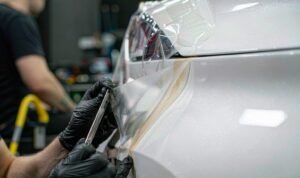
Step 4. Heat and peel one panel at a time. Warm the film to 45 to 60 C, lift an edge with a plastic razor, and pull back on itself at a low angle in slow, steady strokes. Re-heat anything that fights you; force is what marks paint. Work tucked edges, mirror bases and door handles first, while surrounding film is still warm, because cold tucked vinyl is what breaks trim.
Step 5. Clean the residue. Apply a clearcoat-safe adhesive remover, respect the label dwell time, wipe in one direction with a microfiber, and repeat rather than scrub. Then wash the panel thoroughly, because leftover solvent film will fight any new wrap or coating applied afterward.
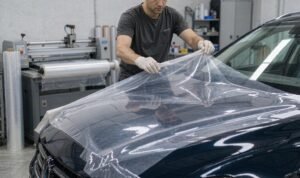
Step 6. Inspect under daylight and photograph the result. Bare, clean, inspected paint is also the perfect moment to sell the next job, whether that is fresh Araba Kaplama Vinil or long-term protection film.
Case in point. One shop, one month, two cars. The first was a garage-kept sedan in 3-year-old cast wrap: full removal in about 6 hours, residue under 3 percent of panel area, one bottle of solvent, quoted and billed at 600 dollars. The second was a daily driver in 6-year-old calendered vinyl, parked outside its whole life: 18 hours across two days, film coming off in fragments, residue near 15 percent before cleanup, plus one resprayed fender that the test pull flagged early, re-quoted as paint correction for another 450 dollars. Same car size, wildly different economics. The only honest way to price removal is by condition, and the test pull in Step 3 is what converts condition into a quote.
What this means before the film ever goes on
Removal economics are mostly decided on installation day. Cast vinyl with a clean adhesive system out-removes budget calendered film by years, and the material difference shows up in the car wrap vinyl materials guides on film construction and adhesive types. The same logic applies to entry-level films: TPH PPF film behaves differently under heat and age than cast vinyl, so never price its removal on cast-film assumptions. And if a customer ever asks whether wrapping is worth it compared with other protection options, the honest frame is total lifecycle cost, where a quality film’s removal day is just one line item among many across the life of the araba filmi.
The verdict
A wrap’s removal story is written the day it is installed; on removal day, your only job is to read it correctly with a thermometer, a protractor and one ten-centimeter test pull.