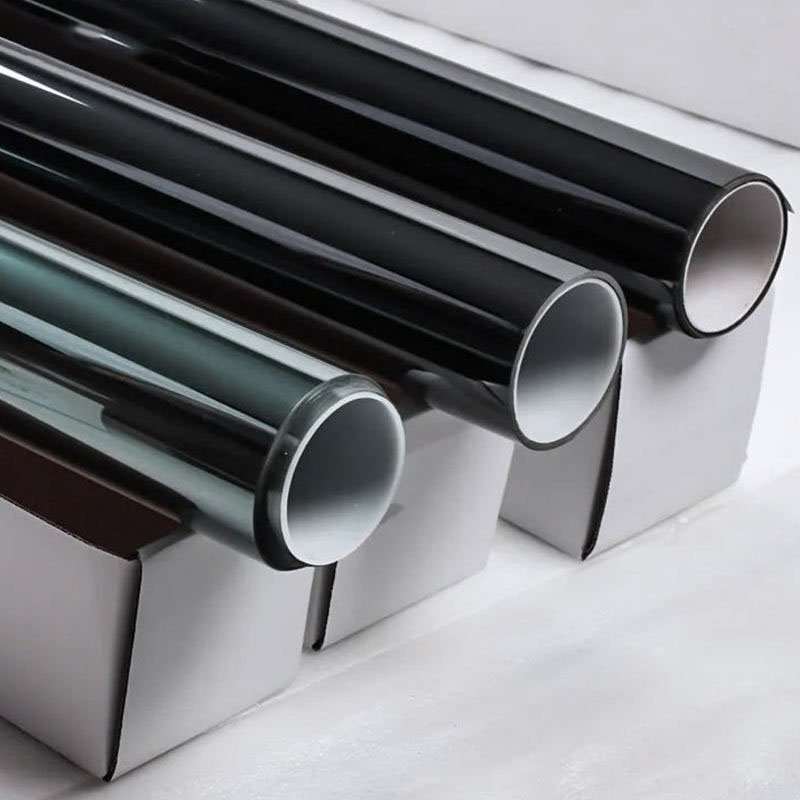

The mainstream materials for windshield tint film are multi-layer metal film and ceramic film:
Metal film: Magnetron sputtering technology, strong insulation (such as quantum diamond 70 insulation rate of 55%), but may slightly interfere with the signal
Ceramic film: Nano ceramic coating (such as dragon film crystal 80 with a thermal insulation rate of 47%), no signal shielding, suitable for new energy vehicles
Key parameters: Transmittance should be ≥ 70%, and UV blocking rate is recommended to be above 99%
PET substrate: Mainstream automotive ceramic films (such as Meiji V10 titanium nitride ceramic film) use polyethylene terephthalate (PET) as the substrate, and ceramic particles such as titanium nitride and zirconia are implanted into the substrate through magnetron sputtering or nanotechnology to form a multi-layer composite structure. This design combines high transparency (≥ 70%) and strong thermal insulation
Structural features: It usually includes a wear-resistant layer (4H hardness), a metal layer (vacuum aluminum plating), and an adhesive layer (pressure-sensitive adhesive). Some products adopt a “shallow front and deep back” gradient design

Partículas de sustrato de PET de alta gama y adhesivos de marcas importadas

Different Window tint are compatible with a 3-5 year warranty

Certificado por CE y ROHS, respetuoso con el medio ambiente y seguro

Entrega rápida de mercancías al contado, aproximadamente de 7 a 15 días, admitiendo flete marítimo y aéreo
| Comparison Item | Metal Film | Ceramic Film |
| Heat Insulation | Reflective insulation, 61% IR reflectivity | Absorptive insulation, stable performance |
| Signal Interference | May block GPS/ETC signals | No metal layer, no signal interference |
| Durability | Prone to oxidation, 5-year warranty | Oxidation-resistant, 5–10-year warranty |
| Light Transmittance | Darker tint, may affect visibility | High transparency, clear vision |
| Price | Cost-effective | Technologically costly, relatively expensive |

| Producto | Car window tint film |
| Material | PET |
| Espesor | 2 mil |
| Talla | 1.52*30 m |
| VLT | 15 |
| UVR | 99 |
| IRR | 92 |
| TSER | 89 |
La película de cambio de color para coches es un material de película delgada que se aplica a la superficie de un coche, que puede cambiar el color de la carrocería sin dañar la pintura original, al tiempo que proporciona ciertas funciones de protección. De acuerdo con los diferentes materiales y funciones, TPU película de cambio de color tiene materiales de gama alta y combina el cambio de color y las funciones de ropa de coche invisible.


The mainstream materials for windshield film are multi-layer metal film and ceramic film, with the specific material composition as follows:
1. The multi-layer metal film adopts magnetron sputtering technology to uniformly sputter rare metals such as gold, silver, titanium, nickel, chromium, etc. onto the PET substrate.
2. In the field of automotive ceramic film, PET (polyethylene terephthalate) is commonly used as the substrate, such as the Meiji V10 titanium nitride ceramic film, which implants titanium nitride ceramic particles into the PET substrate.
1. Evite lavar los bordes con pistolas de agua a alta presión: No lave el coche en los 10 días siguientes a la aplicación de la película, y no se recomienda lavar el coche en los 7 días siguientes,
2. Limpieza a tiempo de las manchas difíciles: Las manchas corrosivas, como las de aceite y chicle, deben limpiarse en un plazo de 24 horas,
3. Evite los ambientes extremos: La exposición prolongada a la luz solar o la calefacción y refrigeración irregulares pueden acelerar el envejecimiento
1. El precio de la envoltura invisible de TPU para coches, rentable y económica, oscila entre $250 y $400 por rollo.
2. Utiliza material de base TPU alifático importado, especialmente diseñado para modelos de coches de lujo con un precio superior a 300000 yuanes, con un fuerte rendimiento de protección y una garantía de 10 años. El coste de la lámina para automóviles es de aproximadamente $500 por rollo.
3. Material compuesto de TPU multicapa, adecuado para coches de lujo de un millón de niveles o vehículos con requisitos de proceso especiales, con un precio aproximado de $1000 por rollo.