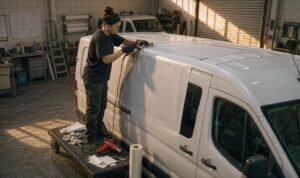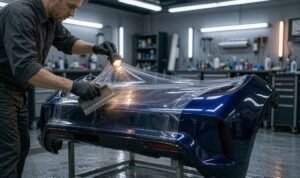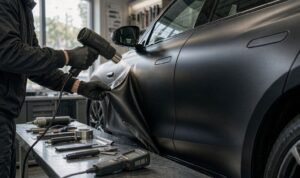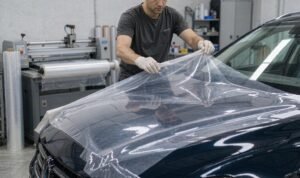
The bumper that looked perfect for three weeks
A detailer in Manchester took a call from a body shop he had used for years. A three-year-old estate had a new front bumper cover, sprayed on Thursday, low-baked at 60°C, ready for collection on Monday. The owner wanted film on it before the car went back on the motorway. The shop had a free bay on Tuesday. Everyone agreed that was efficient.
Three weeks later the customer sent a photo: four cloudy blisters the size of a fingernail across the upper face of the bumper, right where the sun lands. Nothing had obviously gone wrong. The film was a decent Clear TPU PPF product, the bay was clean, and the panel was flat and dry at handover. What failed was underneath the film, not in it.
Fresh paint keeps releasing solvent long after it feels dry. A urethane film is a fairly good vapour barrier, so anything that blocks the escape route pushes solvent back into the clear coat, where it expands under sun load and lifts the adhesive in small domes. The film gets blamed, the installer eats the rework, and the body shop never hears about it.
Four numbers decide whether a repainted panel can take film
1. Outgassing time, counted from the spray date
Industry scheduling guidance is consistent enough to quote. Solvent-borne two-pack clear: 30 days minimum before film, 60 is the safer number. Waterborne systems: 60 to 90 days, because water leaves more slowly than solvent. Air-dried panels with no bake: 90 days and up. A 60°C low bake sets the surface enough to sand and polish, but it does not finish the job, and a full oven cure is not available once the car is assembled.
OEM paint is a different animal. Body shells are cured at 140°C and above before assembly, so a factory panel is fully cross-linked by the time you touch it. A refinish panel is not, and no amount of IR lamp time changes the chemistry inside the clear coat.
2. Film build, which sets how much solvent is in there
Typical OEM clear coat runs 35 to 55 microns over a total film build near 90 to 120 microns. A refinish job usually lands higher: 45 to 65 microns of clear, 100 to 160 microns total. High-solids clears carry less solvent per coat but release it more slowly. So the thicker the fresh clear, the longer the panel breathes, and the worse the consequences of filming early.
3. Surface energy, which decides whether the adhesive can hold at all
Adhesive bonds to surface energy, not to gloss. A properly cleaned, fully cured clear coat sits around 34 to 38 mN/m, which is enough for a 15 to 25 N/25 mm peel value on a standard 180-degree test. Below roughly 32 mN/m, wet-out fails and you get silvering that no squeegee technique will fix. Fresh clear can read high on a dyne pen and still be a bad substrate, because the top layer is still mobile. Cross-hatch adhesion per ASTM D3359 is the acceptance test that matters: 4B minimum on a painted metal panel, and often no better than 3B on a plastic bumper cover even when everything is right, which is why adhesion promoter exists.
4. The 72-hour coupon test
It is the cheapest insurance in the trade, and almost nobody runs it. Take a 100 by 100 mm offcut of the same film, apply it to a hidden area of the repainted panel, and hold it at 45 to 50°C for 72 hours in a warm cabinet or in direct sun under a dark cover. Then peel it and look. A ghosted imprint, a milky patch, or a solvent smell at the edge means the panel is still working. No imprint, no haze change beyond 1 percent, and the panel is ready. It costs one scrap of film and three days of patience, it converts an argument into a measurement, and it catches the substrate problem that later shows up as PPF edges lift eight weeks after handover.
What to ask before you book the bay
| Ask this | Why it matters | Acceptable range |
|---|---|---|
| Which paint system and clear did you use? | Different chemistries release solvent at very different rates | Named product with the technical data sheet on file |
| Was the panel baked, and how hot for how long? | A low bake only skins the surface | 60°C for 30 minutes minimum, and still count cure from the spray date |
| What date was it actually sprayed? | The clock starts at spray, not at collection | 30 days minimum, 60 to 90 for waterborne or garage-kept cars |
| How many clear coats, and what film build? | More clear means more solvent to release | 45 to 65 microns of clear, 100 to 160 microns total |
| Was filler, plastic primer or an adhesion promoter used? | These substrates absorb and bond differently | Declared in writing, with promoter specified on plastic covers |
| Can I test a hidden area first? | The only proof that survives a warranty argument | 100 by 100 mm coupon, 72 hours at 45 to 50°C, no imprint |
| Who owns the rework if it blisters? | Film warranties exclude substrate failure by default | Agreed in writing before the car is booked in |
How to schedule film around fresh paint
Step 1. Log the spray date at intake. Ask for the painter’s job card and write the number down. Every later decision hangs off that date.
Step 2. Split the panel list. If a car has one repainted door among nine original panels, film the original eight now and leave the door bare or offer a return visit. Quoting the whole car as one job is how shops end up redoing a door and losing the full-front margin.
Step 3. Run the coupon test at day 30. On a waterborne repair or a car that lives in a garage, run it at day 60. Ninety days if the panel was air-dried in a cold workshop. If the coupon ghosts, wait another two weeks and repeat. This is the only test that reflects the actual substrate rather than a generic rule.
Step 4. Prep without loading the surface. Two-stage wash, then an IPA wipe at 10 to 30 percent. No wax, no silicone polish, no glaze. Clay only if the paint is genuinely cured, and never wet-sand a fresh panel to win a gloss argument.
Step 5. Install and post-heat normally. Standard slip solution, edges wrapped, 90 to 105°C at the edge. Fresh paint is not more delicate during the fit, it is more delicate afterwards, because the adhesive bond is competing with an active substrate, which is why the same routine that works on any Transparent TPU PPF install is enough here.
Step 6. Inspect at day 7 and day 30. Blistering is rated per ASTM D714, and 8F or better is the pass line. Any dome above 2 mm, any haze increase beyond 1 percent by ASTM D1003, and you remove the film while it is still soft rather than letting it cure onto a failing panel.
Case in point. Two shops, same Mercedes bumper cover, roughly 1.1 square metres of film. Shop A filmed on day four: 28 dollars of film, 3.5 hours at 90 dollars, so 343 dollars. At day 21 the blisters appeared, and the fix was another 28 dollars of film, 3.5 more hours and a 120-dollar goodwill detail, taking the job to about 800 dollars, plus the body shop’s referral. Shop B held the car for 45 days, filmed in 3.2 hours for 318 dollars, and never touched it again. Same film, same technician skill, roughly 480 dollars of difference per bumper. On a dealer account doing four repainted bumpers a month, that is a quarter of a person’s wage.
The stance
Film is not a sealer for impatience. A panel that is still curing will always beat a good adhesive, so the shops that make money on repainted cars are the ones that quote the waiting period as part of the job instead of absorbing the failure six weeks later. For buyers specifying film for body shop accounts, put the cure window in the supply agreement, not just the technical data sheet, because the film is usually the only component anyone can point at when a blister appears, and a автомобилен филм supplier who asks for the spray date is worth more than one who only quotes a roll price.