The callback that starts at a corner
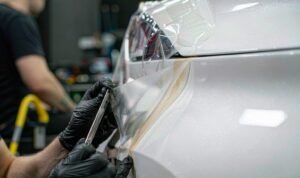
A shop delivered a full-front Clear TPU PPF job on a white SUV in early September. The install looked clean: gloss was right, no stretch marks, the customer paid a premium price and left happy. Forty-one days later the car came back with a lifted corner on the hood leading edge and a curling line along one fender. The shop re-seated both edges free of charge, and the owner quietly started testing a different film supplier, convinced the film itself was the problem.
The film was not the problem. A peeled corner like that almost always traces back to what happened in the last centimeter of the install: an edge trimmed flush with no mechanical wrap, adhesive that never reached full cure, or moisture and minerals trapped at the bond line. Suppliers get blamed for bondline mistakes they never see. If you buy or resell film, learning to audit edge work protects your margin and your supplier relationship at the same time. Here are the numbers that separate an edge built to last from one running on a timer.
Four measurable dimensions of edge quality
Post-heat temperature at every edge
Pressure-sensitive adhesive on quality TPU PPF is engineered to build bond over time, but heat is what finishes the job at the perimeter. The working window most film makers publish sits between 90 and 105 degrees Celsius at the film surface, verified with an infrared thermometer rather than estimated by feel. Below roughly 80 degrees you flash off some moisture but the adhesive never builds full tack, and any film stretched into a curve keeps its memory and starts pulling back the moment the car parks in the sun. Push past about 110 degrees and you risk glazing the topcoat and distorting the film. Post-heating is not optional on stretched zones, and it is not optional on edges that already look flat. In practice the edge that fails is rarely the one the installer worried about.
Edge wrap versus trim flush
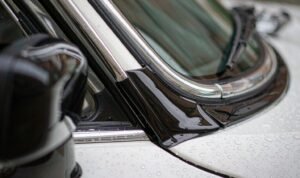
A wrapped edge carries the film 3 to 6 millimeters around the panel edge, so the bond line sits where fingers and wash mitts never reach. A trim-flush edge leaves raw film on the panel face with no mechanical hold; wind load, thermal cycling, and every car wash attack that line from day one. Trimmed installs are sometimes unavoidable on complex bumper geometry, but the decision should be made before the film gets wet, because an improvised trim usually means the installer stretched the piece to reach the edge, and a stretched edge is a loaded spring waiting for heat cycles.
Cure time before the car goes back to work
The bond does not peak on delivery day. Most pressure-sensitive PPF adhesives build toward their rated 180-degree peel strength, measured under ASTM D3330, across 24 to 72 hours as residual installation fluid flashes off and the bond wets out fully. That is why industry practice treats the first 24 to 48 hours as a no-wash window, and why serious shops keep pressure washers away from edges for at least the first week. A car delivered at five in the afternoon and hand-washed the next morning is a comeback on schedule.
Bondline cleanliness and solution discipline
Slip solution left under the last inch of film is the quiet killer. Tap water leaves mineral residue at the bond line after it evaporates, and those minerals sit exactly where adhesion matters most. Disciplined installers use distilled water for both slip and tack solution, displace slip at the perimeter with tack, and finish with a heat pass that drives off the last moisture. Alcohol and adhesive promoter tricks borrowed from other product families do not belong in a water-based PPF process, and touching the adhesive side with bare fingers transfers oils that permanently kill local tack. Ambient conditions belong on the same list: most film makers specify roughly 40 to 60 percent relative humidity and an 18 to 26 degree Celsius shop for installation.
The checklist to run before handover
| Ask before delivery | Why it matters | Acceptable range |
|---|---|---|
| Post-heat temperature at edges | Confirms adhesive activation and memory release | 90 to 105 C, verified with an IR thermometer |
| Edge treatment per panel | Wrapped edges survive wash load; trimmed edges rely on adhesive alone | 3 to 6 mm wrap-around where panel geometry allows |
| Time before first wash | Adhesive needs build time to reach rated peel strength | 24 to 48 hours minimum, 7 days before pressure washing near edges |
| Install solution | Mineral residue at the bond line weakens adhesion | Distilled water for slip and tack, no alcohol at edges |
| Shop temperature and humidity | Cold panels and high humidity slow cure and trap moisture | 18 to 26 C shop, 40 to 60 percent RH |
How to audit an install in fifteen minutes
Step 1. Check the environment before the car. If the bay reads under 15 degrees Celsius on a cold morning, nothing downstream is reliable; adhesive wet-out slows dramatically and squeegee work goes stiff. Ask what the shop does in winter before you ask anything about the film.
Step 2. Walk the edges before you admire the gloss. Hood, fenders, mirror caps, bumper returns. A wrapped edge disappears into the body line, while a trimmed edge shows a fine line that catches a fingernail. Trim is acceptable where geometry demands it, but it should be tight and consistent, not ragged.
Step 3. Ask to see the infrared thermometer. A shop that post-heats properly owns one and uses it on every edge of every panel. If the answer is that they heat until it looks right, expect callbacks during the first hot month after delivery.
Step 4. Get the cure window in writing. The delivery sheet should state 24 to 48 hours before the first wash and a week before pressure gets near any edge. No sheet means no accountability when the dispute starts.
Step 5. Re-inspect at day 7 and day 30. Edge failures from install-day shortcuts almost always surface inside 90 days, so adhesive that survives the first month with a flat, quiet perimeter has effectively passed the test. If your crew is still building these habits, pair the audit with the professional versus DIY installation risks we broke down earlier, because the failure modes are the same at every skill level.
The same lot of Clear TPU PPF went to two shops in the same city within one week, and the outcome shows how little material has to do with it. Shop A trimmed every panel flush, post-heated by feel, and washed the first car at hour 14. By week 9 it had four lifted edges across three vehicles and spent roughly eleven labor hours on rework, plus a goodwill discount it could not invoice. Shop B wrapped 4 to 5 millimeters wherever geometry allowed, verified 95 to 100 degrees Celsius at every edge with an IR gun, and held every car for 30 hours before release. Same film, same batch, same installed price: zero callbacks through six months. The difference was four numbers the second shop refused to skip.
The edge is the product
Buyers spend enormous energy comparing thickness, topcoat chemistry, and yellowing warranties, then hand the car back with a bondline nobody verified. Film makers publish adhesive build data under standards like ASTM D3330 and film elongation behavior under ASTM D882 because the bond is engineered, not automatic; installer edge discipline is what lets that engineering reach the panel. When you source فيلم السيارة for your shop, weigh a supplier who will train your crew on edge protocol as heavily as you weigh price per meter, and hold your own bays to the same standard. Most PPF failures inside the first year are not film failures, they are edge failures, and edges are the cheapest thing on the car to get right.