The van that broke the quote
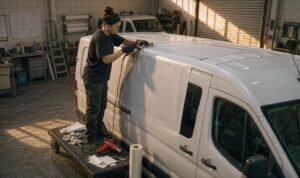
A shop in Rotterdam won a full colour change on a Sprinter 2500 high roof at a price built from its usual SUV template. The van arrived on a Monday, the roll was 1.52 metres wide, and the roof was 2.0 metres across. By Tuesday the installer had two choices: a seam down the centre of a roof nobody photographs, or enough stretch to reach both gutters and hope it held.
He pulled. Three weeks later, 400 mm of the roof edge had lifted and the shop was redoing five metres of film in a week already sold to other customers. The quote was never the problem; the width of the film was treated as a detail instead of a constraint.
Four numbers that decide the seam plan
1. Usable width, not nominal width
A standard 자동차 랩 비닐 roll is 1.52 m, which is 60 inches. Nobody installs to the last millimetre. Trim 10 to 20 mm off each edge for a clean line and the usable width is 1.48 to 1.50 m. Every panel whose shorter side exceeds that number needs a seam, a second piece, or a stretch that will come back.
The list of panels that cross the line is longer than most quotes admit. Sprinter and Transit roofs run 1.9 to 2.0 m. Full-size SUV roofs sit around 1.5 to 1.7 m. Heavy-duty pickup hoods reach 1.5 to 1.7 m at the rear. Long bedsides are a length problem, not a width problem, which is why a crew-cab truck needs more metres but fewer seams than a van.
2. Seam count, which belongs in the quote
Seam count is a spec you can put on paper before the car is in the bay. Typical numbers by vehicle class: sedan or hatchback 0 to 2, mid-size SUV 2 to 4, full-size SUV or van 4 to 8, box truck or bus 10 and up. Each seam costs 15 to 25 minutes of extra labour, a length of knifeless tape, and a visible line the customer will find in the first week.
Quoting a seam-free price and delivering six seams is how a wrap shop loses a fleet account; quoting them up front with a diagram is what makes the number defensible.
3. Seam geometry, which decides whether it disappears
Four measurements do most of the work. Overlap before cutting should be 3 to 6 mm, then cut through both layers in one pass; after the waste strip is pulled the joint should close to a gap of 0 to 0.5 mm. The upper piece must overlap the lower one so water sheds downward instead of wicking under the edge. Placement should follow a factory panel gap or a concave shadow line, never the crown of a convex surface, and stay at least 100 mm clear of a tight radius or a door handle recess. Post-heating runs 90 to 100°C over the seam at roughly 10 to 15 seconds per 100 mm, with the edge sealed while the film is still warm.
A failing seam is almost always one of those four. Adhesion along the finished seam, checked at 24 hours with a cross-hatch per ASTM D3359, should reach 4B; a seam that peels clean at 2B was never bonded, only laid down.
4. Film construction, which decides whether the seam survives the first summer
Cast film and calendered film behave differently at a joint. Cast film is typically 3.5 to 4 mil with elongation well past 200 percent and shrink under 1 percent at 100°C, so a seam stays closed. Calendered film is 2 to 3 mil with a few percent shrink under the same heat, and that movement opens a 0.5 mm gap into a 2 mm gap over one summer. On a 1.52 m roll, the material choice is not a price decision, it is a seam decision.
Colour and finish matter too. Gloss shows a seam at three metres, satin and matte at one, and light colours collect a dirt line along any overlap within weeks.
If the goal is a colour change with protection underneath, a 컬러 TPU PPF roll ships at the same 1.52 m, so the width problem does not change with the material.
The questions that keep a wrap quote honest
| Ask this | Why it matters | Acceptable range |
|---|---|---|
| What is the usable width after edge trim? | Decides single-piece versus seamed panels | 1.48 to 1.50 m from a 1.52 m roll |
| Which panels exceed 1.50 m on the short side? | Sets the seam count before cutting | Listed per panel, with a sketch |
| How many seams are in this quote? | A hidden seam count is a hidden cost | Declared in writing, per panel |
| Overlap width and cut method | Too much overlap shows a ridge, too little opens | 3 to 6 mm overlap, knifeless tape, 0 to 0.5 mm final gap |
| Where is each seam placed? | Visibility and water shedding both depend on it | Factory gap or concave line, top piece over bottom |
| Post-heat temperature and dwell | Cold seams shrink back within weeks | 90 to 100°C, 10 to 15 seconds per 100 mm |
| Cast or calendered film? | Calendered seams open in heat | Cast, shrink under 1 percent at 100°C |
| Seam adhesion at 24 hours | Predicts lifting better than a visual check | ASTM D3359 4B or better |
How to plan a wide vehicle before the roll is cut
Step 1. Measure the short side of every panel. Tape measure across the roof, the hood at its widest point, the bedside height. Write the numbers on the job sheet, because memory always rounds down.
Step 2. Draw the seam plan on paper. Mark where each joint lands, which piece goes on top, and the direction of water travel. Five minutes with a pen beats an argument in front of the customer.
Step 3. Order length, not area. Film is sold by the metre off a fixed width, so the quantity is the sum of the runs each panel pulls, plus 10 to 15 percent for alignment and redo. A van that needs 18 metres will not be covered by 17, and a reordered roll from another batch can sit a shade off at the seam.
Step 4. Dry-fit the first wide panel before you pull the liner. Offer the piece up, check that the seam line lands where the plan says, and confirm the overlap direction. This is the last cheap moment in the job.
Step 5. Cut, seal and heat. Overlap, cut through both layers with knifeless tape, pull the waste, press the joint, then post-heat and seal the edge. Never cut a seam with a blade straight on paint: the score line stays hidden until removal, which turns a seam problem into a paint problem, a risk covered in removing car wrap vinyl.
Step 6. Recheck at day 7. Any gap over 1 mm, any ridge you can feel with a fingernail, any edge lift, and it gets reworked while the adhesive is still fresh. After 30 days the film has taken a set and the fix costs a panel.
Case in point. Two Sprinters, same 2.0 m roof, same colour. Shop A planned six seams, ordered 22 metres of cast film and spent 26 hours, billing 2,210 dollars in labour plus film. Shop B went for one piece with roughly 30 percent stretch on the roof, used 18 metres and 22 hours, and finished a day earlier. Three weeks later the roof edge lifted 400 mm along the gutter. The redo took five metres of film and seven hours, and pushed the job to about 2,545 dollars, still not counting the review the customer left. Shop A charged more, finished later, and kept the account.
The stance
A seam is not a defect. It is a decision made before the first cut, and the shops that hide them best are the ones that price them openly. If you buy film for a dealer or fleet programme, ask for usable width and shrink before price per metre: a roll 20 mm narrower than assumed costs more than the discount you negotiated.
At the supply end the same discipline applies: specify width, thickness tolerance and shrink in writing, and buy from a 자동차 필름 supplier who will confirm all three rather than only quoting a roll price.